




On this page
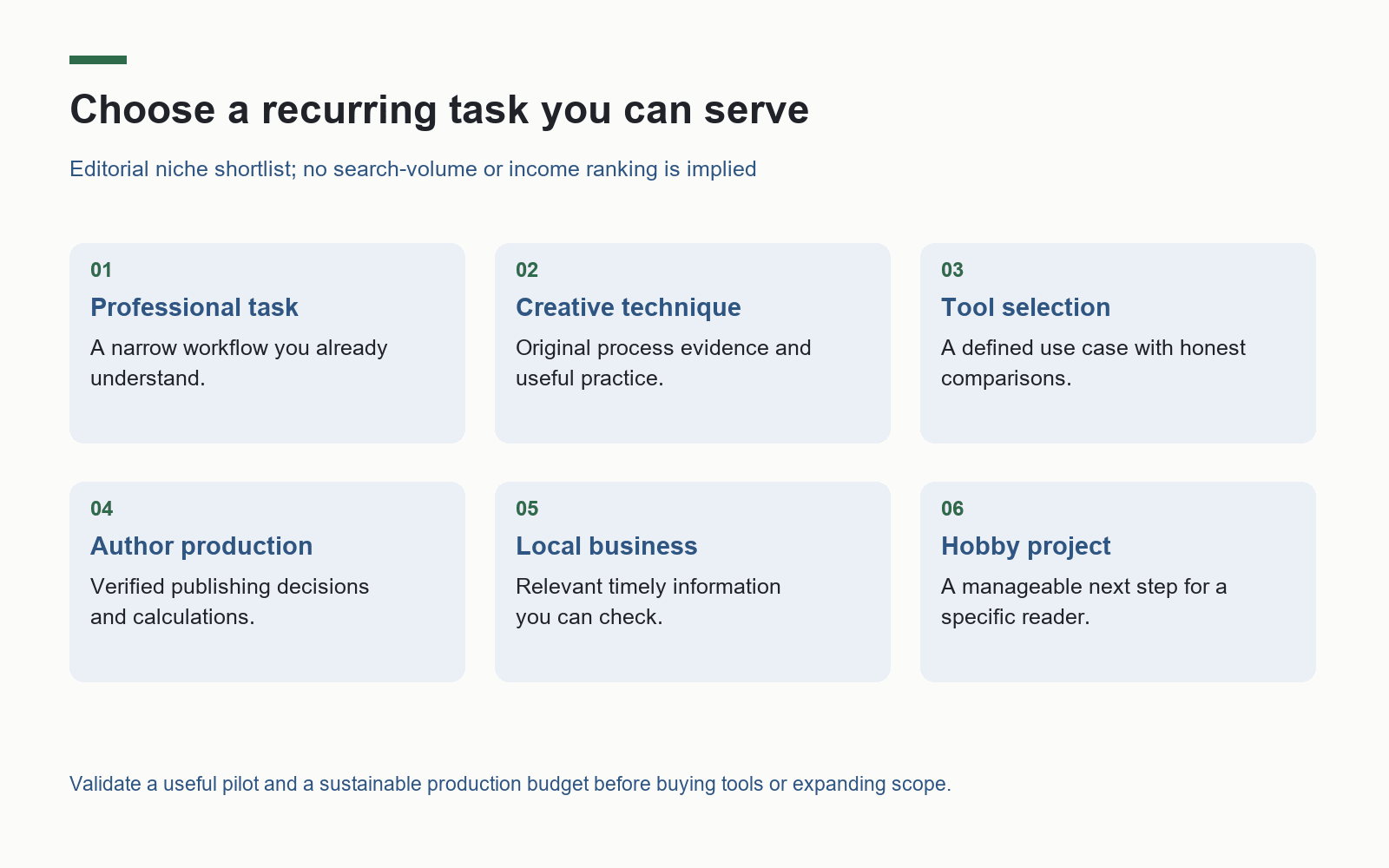
Newsletter niche ideas are strongest when they identify a recurring reader task you can serve with credible original work. Checked November 28, 2026, our first pick is a narrow professional workflow you already understand. Choose a useful repeatable problem before a fashionable broad category, and check production effort before promising a frequent edition.
How should you judge a newsletter niche?
Judge the reader, recurring need, evidence access and the work needed to deliver. A broad label such as technology or lifestyle is not yet a publication promise. A useful niche says who receives the edition and what decision becomes easier.
The six directions below are editorial starting points, not measured keyword rankings or proven high-income niches. We have not launched these publications. Google’s people-first guidance supports focusing on useful original work; it does not verify demand for any idea in this list.
1. Start with a professional workflow you know
This is our first pick because existing experience can make your examples and judgment more specific. A publication for independent audio editors, for example, could explain file handoffs, revision preparation and tools for a clearly defined work situation.
The recurring promise should solve a task, not summarize every industry headline. Show what changed, what remains useful and who should ignore the update. Keep confidential client material out of examples unless you have permission.
This suits someone with real experience and access to current information. Skip it if credibility depends on an invented career history or if the work requires regulated advice you cannot provide.
2. Explain practical creative techniques
A creative-technique publication can help readers improve a specific practice through original exercises and demonstrations. Choose a bounded craft or medium rather than promising mastery of every creative tool.
Plan the evidence: source sketches, process photographs, intermediate results and honest limitations. A generated editorial picture can introduce an idea, but it cannot prove that a physical technique worked.
This suits a maker who enjoys teaching and can produce repeatable examples. Skip it when the apparent opportunity depends on copying another artist’s distinctive work or showing a process you have not performed.
3. Curate tools for one well-defined use case
A tool-selection publication can help readers avoid unsuitable purchases. Narrow the user and constraint, such as recording in a small untreated space, rather than collecting expensive products with no evaluation criteria.
Separate hands-on evidence from specifications. If you have not used a product, do not write as if you have. A clear documentation comparison can still be useful when its limits are explicit.
This suits someone who can maintain product information and investigate trade-offs. Skip it if affiliate availability is the only reason to recommend an item. Our affiliate marketing guide explains the commercial distinction.
4. Serve independent authors with production decisions
An author-focused publication can cover a recurring production task: layout checks, proof preparation, cost calculations or keeping editions consistent. A specific operational focus is more useful than recycled promises of publishing success.
Use official documentation for rules and actual examples where available. Our KDP royalty guide shows how a calculation can be useful without implying that the book will sell.
This suits someone who can verify changing platform requirements and demonstrate editorial work. Skip it if the planned hook is effortless income from mass-produced books.
5. Build a local independent-business briefing
A local business briefing can organize practical information for a defined area and reader type. It might cover suitable events, procurement opportunities or official operational updates, with clear dates and sources.
The local advantage is access and relevance, not an excuse to repeat unverified rumours. Check official notices and obtain permission for material supplied by businesses. Distinguish an advertisement from an independent inclusion.
This suits someone who can maintain local relationships and verify timely information. Skip it when you cannot sustain corrections or when the proposed publication would drift into legal or tax advice presented as certainty.
6. Help a hobbyist complete the next project
A project-focused hobby publication can make progress tangible. Choose a specific activity and experience level, then give a manageable next step with the required materials and limitations.
Think beyond inspiration. A reader may need to understand fit, scale, preparation or how to assess the result. A short original demonstration can be more useful than an ambitious roundup of unrelated projects.
This suits someone who practices the activity and can create reliable examples. Skip it if the production cost of every edition is too high for the funding model or the proposed activity needs safety expertise you do not have.
Which newsletter niche ideas are affordable to produce?
The affordable niche is one whose recurring evidence and production you can sustain. Costs include research access, samples, travel, software, photography, editing and support, depending on the subject.
Hypothetical editorial budget: assume four editions each require three hours and USD 10 of cash expenses. The month uses twelve hours and USD 40 before software, overhead and tax. A different niche requiring six hours per edition doubles the editorial time. These invented inputs show how to compare workloads, not typical newsletter costs or earnings.
Use that budget before choosing between paid and free publishing. A narrow audience can still be valuable, but an invented conversion rate is not evidence of funding.
How should you validate one niche?
Write a specific signup promise and draft several ordinary edition ideas. Speak with suitable potential readers about the task, then publish a bounded pilot to people who explicitly requested it. Record useful questions and whether readers return for the next edition.
Do not collect a large list before deciding what to send. A referral reward can support a useful publication, but it cannot repair an unclear reader promise.
Choose the blog or newsletter workflow that fits the subject. Keep one primary format manageable before adding more channels.
Our recommendation: begin with the narrow workflow you can explain best, publish a credible pilot and judge the response before committing to a broader brand or expensive tools.
Sources
- people-first guidance, checked November 28, 2026.
Information only, not financial, tax or legal advice. Fees and prices change, so check the platform before you act. Disclaimer (opens in a new tab)
Was this article helpful?


Comments