




On this page
Newsletter email deliverability begins with permission, a consistent sender identity and correct technical setup. Checked November 28, 2026, our recommendation is to verify those foundations before increasing list size or sending frequency. A successful send does not prove inbox placement, and inbox placement does not prove that a human read or valued the edition.
What do you need for newsletter email deliverability?
You need a legitimate sending service, control of the relevant domain configuration, a clear signup promise and records of subscriber status. If someone else administers the domain, arrange a supported review rather than making speculative DNS changes.
Budget one setup session plus time to resolve any provider-specific issue. A separate paid deliverability tool is not the first requirement for a small publication. Start with the sending provider’s documentation, actual message headers and the reports available to you.
The technical requirements below summarize Google’s email sender guidelines, checked on the stated date. Other mailbox providers can have their own requirements.
Which Gmail requirements matter?
Google distinguishes general senders from bulk senders to personal Gmail accounts. Its guidelines require SPF or DKIM for all senders; the bulk requirements add SPF, DKIM and DMARC, alignment and one-click unsubscribe for relevant subscribed or marketing mail. The requirements also cover transport, DNS, format and spam rates.
Treat this table as a checklist of areas to verify, not a substitute for the complete current rules or your provider’s setup instructions.
| Area | What to confirm | Useful evidence |
|---|---|---|
| Sender identity | Domain and From address are appropriate | Provider setup and a real test message |
| Authentication | Required methods pass for the actual sender | Message headers and domain records |
| Permission | The reader requested the stated publication | Signup and subscriber-status records |
| Unsubscribe | The supported process works and status persists | A controlled test with your own address |
| Delivery health | Problems are investigated before scaling | Provider and mailbox reports |
How do you check the setup in practice?
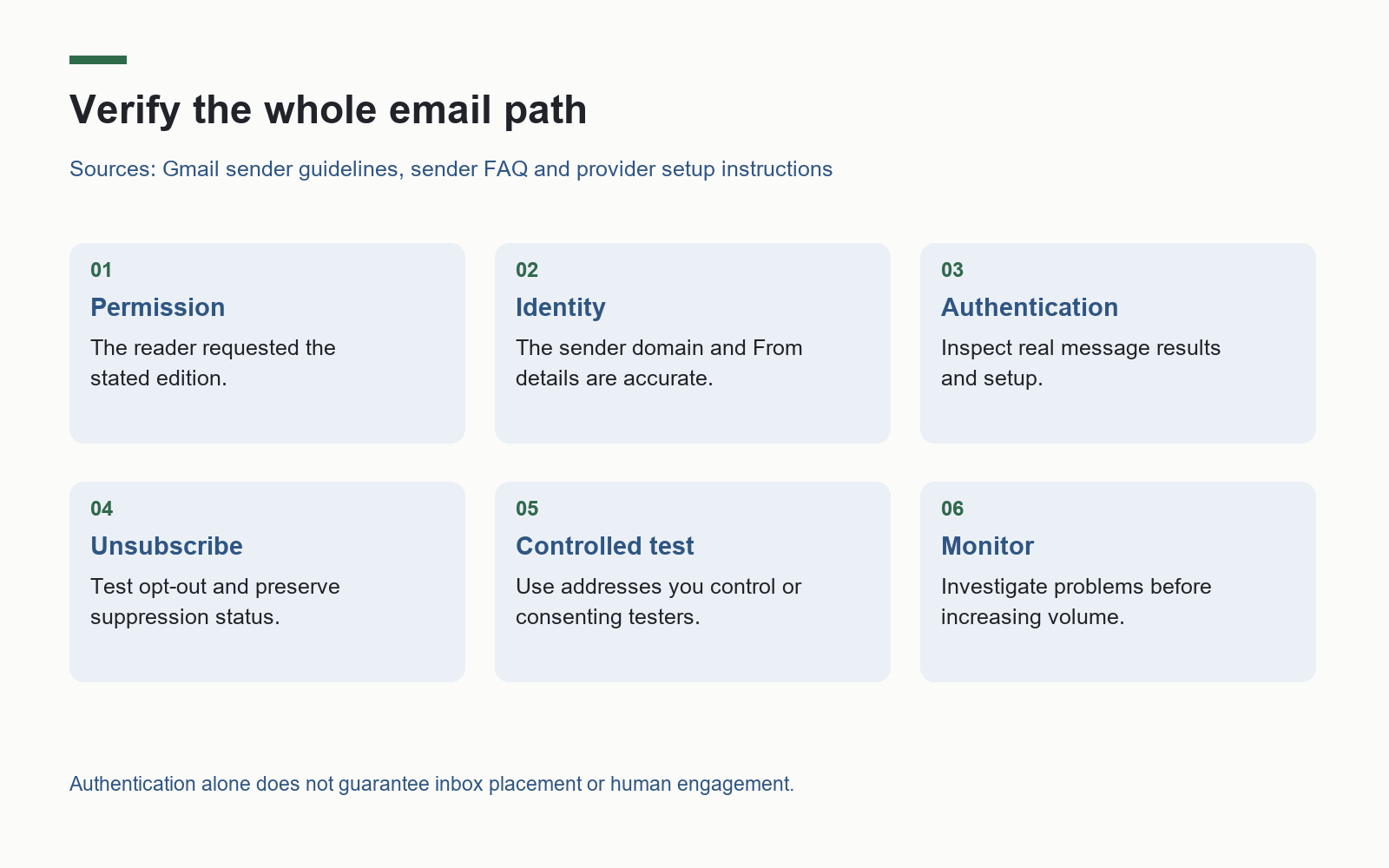
Use a small controlled test and change one thing at a time. Increasing volume during an unresolved configuration problem makes the evidence harder to interpret.
- Review the signup promise and records. Confirm how each contact joined and what they requested. Do not buy lists, silently import unrelated contacts or resubscribe people who opted out.
- Verify the sending identity. Use your provider’s domain-connection instructions and record who can change the DNS. Keep the visible From identity consistent and accurate.
- Inspect a real test message. Send to addresses you control or to consenting testers. Check the provider’s authentication results and the actual headers rather than judging the email only by its appearance.
- Test unsubscribe and suppression. Use your own test subscription to confirm the supported opt-out process. Check that an export or later import does not turn an unsubscribed record back into an active recipient.
- Review problems before raising volume. Investigate bounces, complaints, blocked messages and unexpected engagement. Use the provider’s supported troubleshooting process.
- Keep a recurring review record. Log sender changes, import events, major frequency changes and the resulting reports. This gives a later problem a useful timeline.
Tip: Store a redacted test-message header and the date after a successful setup. It can help your provider compare a later failure with a working configuration.
Why is an unsubscribe link alone sometimes insufficient?
The visible body link and the technical one-click mechanism are different. Google’s sender FAQ explains that applicable one-click requirements use the relevant unsubscribe headers and cannot be satisfied merely by a preferences-page link.
Ask your service whether it implements the required mechanism for your messages. You do not need to invent a custom technical implementation if the provider already supports it correctly.
For legal requirements, the FTC’s CAN-SPAM business guide is a US-facing reference. Other jurisdictions can require different consent and messaging practices. This guide provides general operational information, not individual legal advice.
Why are opens an imperfect business metric?
An open count is a recorded technical event, not a direct observation of human attention. Apple’s Mail Privacy Protection documentation explains protections that prevent senders from reliably learning whether a recipient opened an email.
Use a broader evidence set: useful replies, appropriate clicks, retained subscriptions and outcomes relevant to the reader promise. Do not sell newsletter sponsorships as verified human exposure unless the measurement genuinely supports that claim.
What should you do when changing platforms?
Preserve subscriber status, permission records and the sending identity. Test the new path with a controlled audience before assuming the old configuration carries over.
Our Substack versus beehiiv comparison includes migration questions. A cheaper fee model is a weak reason to rush if the move breaks delivery or paid access.
Our recommendation: make the publication useful and expected, verify the actual setup, and scale gradually from evidence. A referral reward is valuable only when it brings suitable readers you can serve reliably.
Frequently asked questions
Does authentication guarantee inbox placement?
No. It is a technical foundation. Recipient expectations, complaints, sending practices and other factors still matter.
Can I use a purchased newsletter list?
Do not treat purchased contacts as people who requested your publication. Follow your provider’s rules and the consent requirements that apply.
Does every recorded open mean someone read the email?
No. Privacy features and automated activity can affect reporting. Use several appropriate outcome measures.
Should I change DNS records until a test works?
Use the provider’s exact instructions and a supported administrator. Speculative changes can break other services and obscure the cause.
Sources
- email sender guidelines, checked November 28, 2026.
- sender FAQ, checked November 28, 2026.
- FTC’s CAN-SPAM business guide, checked November 28, 2026.
- Apple’s Mail Privacy Protection documentation, checked November 28, 2026.
Information only, not financial, tax or legal advice. Fees and prices change, so check the platform before you act. Disclaimer (opens in a new tab)
Was this article helpful?



Comments