




On this page
Newsletter referral rewards work best when they attract readers who actually want the publication. Checked November 28, 2026, our first pick is a useful original resource that costs little to deliver repeatedly. Choose the reward for audience fit, then budget fulfilment and verification. A referral count is not proof of an engaged subscriber or a profitable acquisition.
What should a referral reward accomplish?
A reward should encourage an existing reader to introduce the right person to a clearly described publication. The new reader must understand what they are joining and make the required choice. A reward is not permission to add someone else’s contacts to your list.
beehiiv’s referral-program description presents milestone-based rewards as a growth tool. Check the actual plan and validation features offered to your account before promising automatic fulfilment.
The ranking below is an editorial shortlist for a small publisher. We have not run these campaigns or measured a subscriber-acquisition rate.
1. Start with a useful original reference sheet
An original reference sheet is our first pick because it can reinforce the publication’s actual value with a bounded delivery obligation. A focused industry newsletter might offer a concise worksheet that helps readers apply its recurring advice.
Make the file accessible, explain its format and check that it works without specialist software the reader was not told about. Keep the resource useful enough to stand on its own; do not call an ordinary index a premium handbook.
This suits a publication with a repeatable practical problem. Skip it if creating a credible resource would require expertise you do not have, or if the proposed file is largely copied from someone else.
2. Offer an organized archive or reading path
An organized reading path can help a new or returning reader use the work you already produced. It might collect your best original explanations in a sensible sequence with short introductions and current links.
Budget the curation and maintenance. An archive full of expired offers is not a dependable reward, and a broken access link creates support work. Do not remove something already promised to current readers just to manufacture scarcity.
This suits an established public archive. Skip it when the publication has too little useful work or when access would conflict with existing paid entitlements.
3. Use a bounded group session
A group session can work when the publication serves a practical learning need. Define the subject, attendance limit if any, recording availability, accessibility and what happens if the session is rescheduled.
Count preparation, moderation and follow-up. A session described casually as a thank-you can become substantial work if every participant expects individual advice.
This suits an editor who already teaches or facilitates groups. Skip it when the subject requires individualized professional advice or the time commitment is uncertain.
4. Give a clearly limited premium preview
A premium preview can demonstrate the paid publication’s value without creating a permanent entitlement. State the duration, included content and what happens at the end. Readers should understand whether any separate subscription action is required.
Coordinate the preview with your platform’s supported access controls. Do not silently start a paid recurring charge when a reward expires. For the offer design, compare paid and free newsletters.
This suits a paid edition whose benefits already work reliably. Skip it when the paid product is still an untested promise or access would need manual handling you cannot sustain.
5. Reserve physical merchandise for proven demand
Physical merchandise can create a tangible connection, but it has the greatest fulfilment burden in this shortlist. Production, shipping, address handling, customs issues and replacements all matter.
Choose an original design and inspect a real sample. Keep the supported destinations and delivery assumptions clear. A generated product scene is not sample evidence.
This suits a publication with a known audience connection and a budget for fulfilment. Skip it when the reward costs more than the value of the readers it reliably attracts or when delivery is difficult to support.
How should you calculate the acquisition cost?
Include every reward issued, the required tools, fraud checks and support. Divide those costs by the genuine retained readers you can attribute to the campaign, using a period appropriate to your publication.
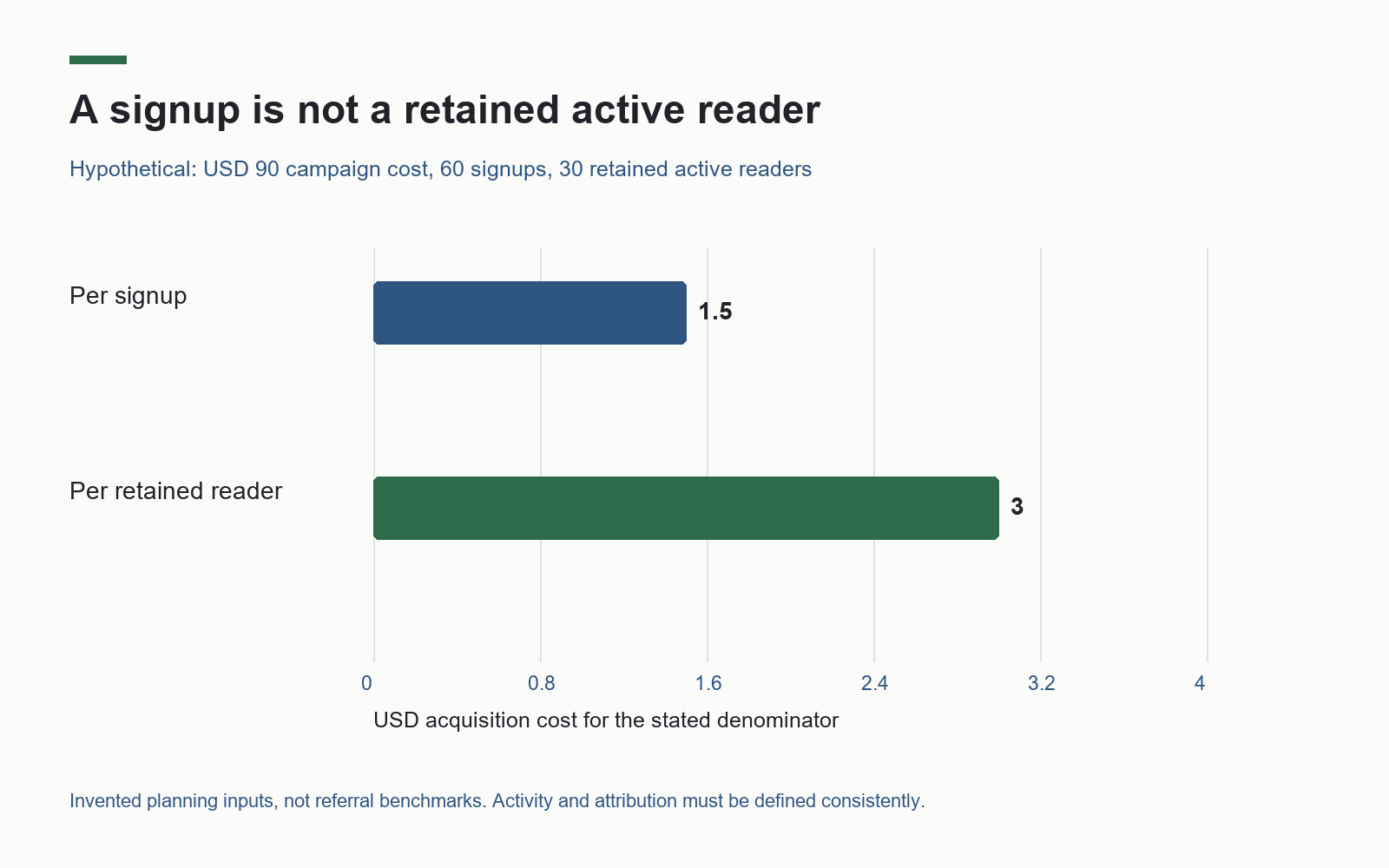
Hypothetical campaign: assume USD 90 total reward and administration cost, 60 attributed signups and 30 readers still meaningfully active at the chosen review point. Cost per signup is USD 1.50; cost per retained active reader is USD 3. These invented inputs demonstrate two different denominators, not a typical referral result.
Do not treat bot signups or repeated self-referrals as growth. Decide how a referral qualifies and when a reward is issued before starting. Use the supported program rules rather than changing the conditions after readers have participated.
Which newsletter referral rewards should you choose?
Choose the smallest reward that genuinely complements the editorial promise. A practical resource or organized reading path is our starting recommendation. The reward should improve the reader’s experience instead of attracting a disconnected giveaway audience.
Use newsletter niche ideas to define the audience, and email deliverability checks to keep consent and subscriber status clear. If the main publication is not valuable enough to recommend, fix that before buying rewards.
Our recommendation: test one low-burden original reward, measure retained readers and expand only after the full acquisition cost makes sense.
Sources
- referral-program description, checked November 28, 2026.
Information only, not financial, tax or legal advice. Fees and prices change, so check the platform before you act. Disclaimer (opens in a new tab)
Was this article helpful?



Comments