




On this page
Blog vs newsletter is a choice about how readers find, receive and revisit your work. Checked November 28, 2026, our default for detailed evergreen explanations is a searchable public blog with an optional newsletter. Choose an email-first publication when readers primarily need timely, recurring judgment. Begin with one dependable publishing workflow before maintaining two separate editorial schedules.
How does blog vs newsletter compare?
A blog gives a useful article a public destination that readers can link to and return to. A newsletter delivers editions to people who signed up, with an ongoing promise about content and frequency. Many services can support both, but the audience jobs remain different.
This is a business and editorial comparison, not a claim that one channel always attracts more readers. Search visibility, inbox placement and paid conversion all need evidence from your own work.
| Question | Blog | Newsletter |
|---|---|---|
| Best starting job | A durable answer readers can find and cite | A recurring edition readers intentionally request |
| Discovery | Search, references, communities and direct visits | Referrals, a public archive, partnerships and signup sources |
| Ongoing maintenance | Update changing information and repair links | Deliver the promise and manage permissions |
| Common revenue fit | Useful affiliate content, products and services | Subscriptions, sponsorships and relevant offers |
| Common measurement trap | Treating search impressions as customer demand | Treating every recorded open as a human reader |
When is a blog the better first choice?
A blog is the better first choice when the reader needs a specific answer that remains useful between editions. A detailed equipment comparison, original tutorial or explanation of a recurring problem can benefit from a stable public address.
Make the page complete enough to use directly. Give the answer early, show evidence, explain limitations and make the next step clear. Google’s people-first content guidance asks publishers to focus on usefulness and trustworthy original work; it does not promise rankings for following a template.
Budget for updates. A pricing comparison that ranks once but becomes inaccurate can harm the reader and your reputation. Keep the source date and identify what should trigger a refresh.
For revenue, a relevant affiliate recommendation can fit a buying question. A page that answers a non-commercial question should not be forced into a product pitch.
When is a newsletter the better first choice?
A newsletter is the better first choice when its recurring selection or judgment saves the reader effort. A focused weekly industry digest can be useful because someone trustworthy decides what deserves attention and what the information means.
Write a clear signup promise: who it serves, what arrives and how often. An email address is permission to deliver that promise under applicable rules, not permission to send unrelated promotions indefinitely.
Choose a cadence you can maintain through an ordinary busy period. A daily schedule can consume the time needed to investigate the subject. A smaller, reliable publication can be more useful than a frequent stream of shallow summaries.
Use newsletter niche ideas to narrow the audience before selecting a platform.
Which channel gives you more control?
Both require operational control rather than a slogan about owning the audience. A public website depends on hosting, a domain and discovery channels. Email depends on consent, a sending service, authentication and recipient choices.
Keep the assets you are entitled to keep: original files, content backups, subscriber permissions and export records. Verify which data and payment relationships can move before assuming portability.
Our Substack versus beehiiv comparison separates platform fee structures from the publishing decision. Lower software cost cannot repair an offer readers do not value.
How can you use both without doubling the workload?
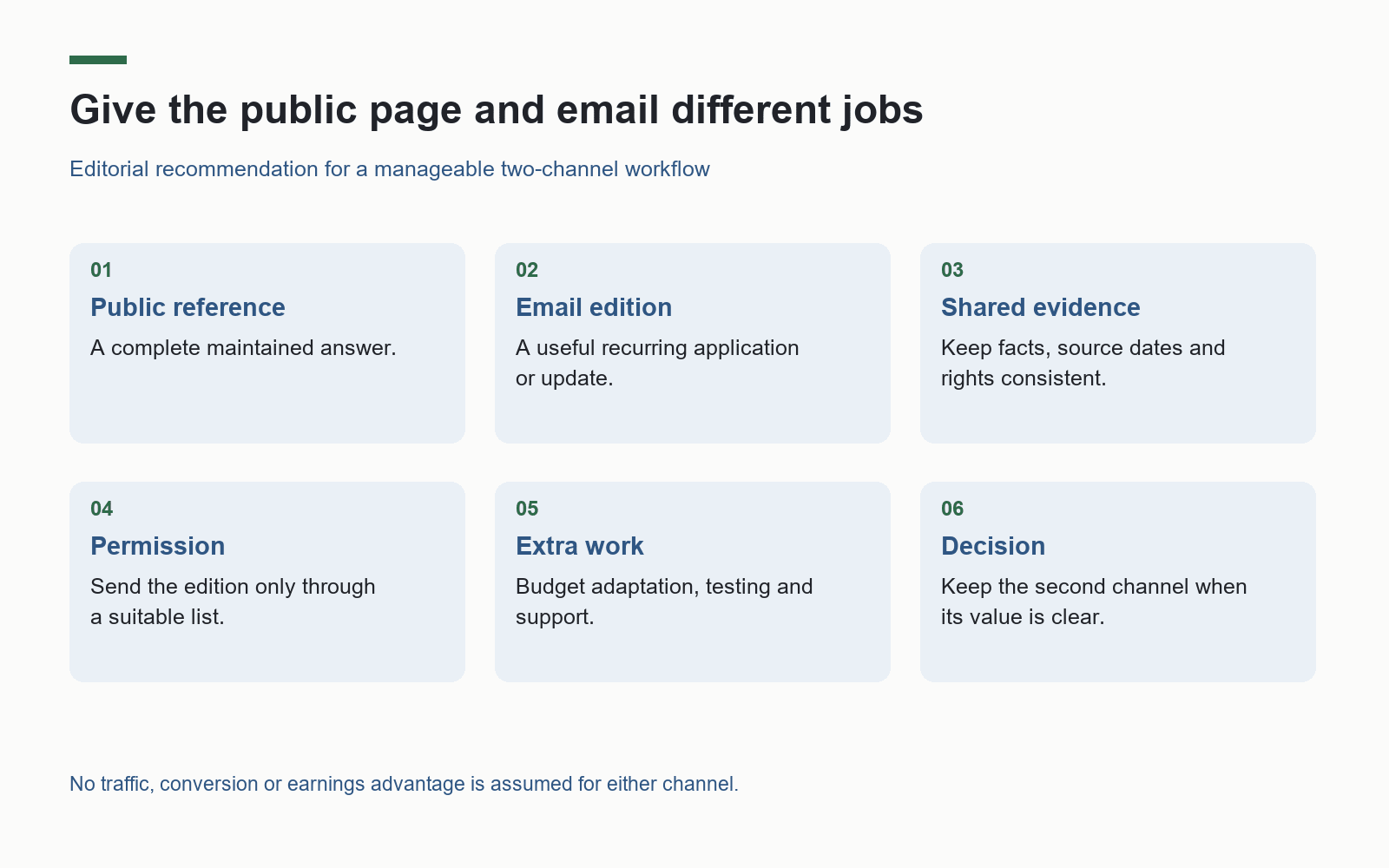
Use a blog article as the complete reference and an email edition as a helpful introduction, update or applied example. Give each version a distinct purpose rather than copying the whole page into every channel automatically.
For instance, the public article might explain how to evaluate a production quote. The email can describe a newly relevant change, why it matters and which part of the guide to use. The reader should gain something from the email even before following its link.
Follow our blog-to-newsletter workflow to preserve factual accuracy and the current source date. Avoid creating conflicting versions that offer different prices or advice.
What costs should you compare?
Compare the complete editorial and technical workload. A blog may require hosting, maintenance and image work. A newsletter may require a paid sending plan, list administration, support and more frequent production.
Hypothetical workload example: suppose a monthly public guide takes eight hours to produce and one hour to maintain. Adapting it into an email takes two additional hours. That combined workflow uses eleven hours, while independently producing another eight-hour newsletter feature would use seventeen. These invented inputs show how to budget shared work; they are not typical production times.
Add cash costs, taxes and the payment route separately. Do not assign an arbitrary value to every subscriber or search visit just to make the preferred channel look profitable.
Which one should you choose?
Choose a blog if the core value is a durable answer, comparison or tutorial. Make that answer complete and maintain it as information changes.
Choose a newsletter if the core value is a recurring selection, analysis or relationship that readers explicitly want. Use email deliverability checks before scaling distribution.
Our default pick: publish the strongest evergreen reference first, then add an optional newsletter with a clear job. Measure useful visits, replies, qualified actions and retained revenue rather than maximizing disconnected traffic metrics.
Frequently asked questions
Can a newsletter also have a public blog?
Yes, many services support public posts and email editions. Decide what each version does for the reader and keep shared facts consistent.
Is a newsletter audience automatically portable?
No. Check exports, permissions, subscriber status and payment arrangements separately before assuming every asset can move.
Does publishing a blog guarantee search traffic?
No. Helpful content and technical access are foundations, not guarantees of discovery or revenue.
Should I start both channels immediately?
Start with the strongest reader need. Add the second channel when you can describe its extra value and sustain the additional work.
Sources
- people-first content guidance, checked November 28, 2026.
Information only, not financial, tax or legal advice. Fees and prices change, so check the platform before you act. Disclaimer (opens in a new tab)
Was this article helpful?



Comments