




On this page
KDP paperback royalties depend on the marketplace, list price, applicable royalty rate and printing cost. Checked November 28, 2026, our recommendation is to price the exact manuscript with Amazon’s calculator before publishing or paying for promotion. The amount left after printing is a royalty, not final profit after editing, cover design, advertising, labour and tax.
What do you need before calculating royalties?
You need the final page count, trim size, ink and paper choices, intended marketplace and list price. A rough manuscript length is not enough if the final layout changes the page count or production specification.
Allow a focused session for the calculation and separate time for proof inspection. Use the KDP printing-cost and royalty calculator rather than buying a third-party calculator to perform the first check.
This guide uses KDP’s published documentation and an illustrative manuscript. We have not published the example book or placed a proof order.
How do KDP paperback royalties work?
For Amazon sales, KDP’s paperback royalty page gives the formula: royalty rate multiplied by list price, minus printing cost. It lists 50% and 60% rates according to price and marketplace. On Amazon.com, the published 60% threshold is USD 9.99; prices at or below USD 9.98 use 50%.
Other marketplaces have their own thresholds, and Expanded Distribution uses a separate calculation. Do not transfer an Amazon.com threshold or ordinary-channel result into every sales route.
How do you calculate an exact manuscript?
Finalize the production specification, then compare price choices using the same book. A change in paper, ink, trim or page count can change the cost as well as the reading experience.
- Complete the reader-facing layout. Check chapter order, pagination, image quality and any workbook space. Avoid manipulating page count solely to make a spreadsheet look better.
- Record the production choices. Write down trim, ink, paper, page count and marketplace exactly as entered in the calculator.
- Check the applicable price tier. Use the current official threshold for the intended marketplace and distribution route.
- Calculate royalty after printing. Keep the result separate from author profit and cash received. Save the calculation date and inputs.
- Add your own cost recovery. Include editing, cover work, proofs, advertising and any paid assets. Consider how much unpaid work remains outside the cash total.
- Inspect a proof and check the offer. Make sure the final book and description match the promise before promoting it. A calculator cannot inspect readability or binding quality.
Tip: Keep each marketplace as a separate row. Currency conversion alone cannot reproduce all local production, pricing and tax conditions.
What does a paperback example leave?
KDP’s printing-cost page provides fixed and per-page costs by specification and marketplace. Use the exact row for the book rather than borrowing another author’s quote.
Illustrative manuscript, not a real book result: consider a 150-page regular-trim black-ink paperback using an applicable Amazon.com fixed cost of USD 1 plus USD 0.012 per page. Printing is USD 2.80. At USD 9.98 and a 50% royalty rate, the calculation is USD 4.99 minus USD 2.80, leaving USD 2.19. At USD 9.99 and 60%, it is USD 5.994 minus USD 2.80, approximately USD 3.19. This uses the published cost and threshold structure checked on the stated date; it excludes author expenses, tax and other adjustments.
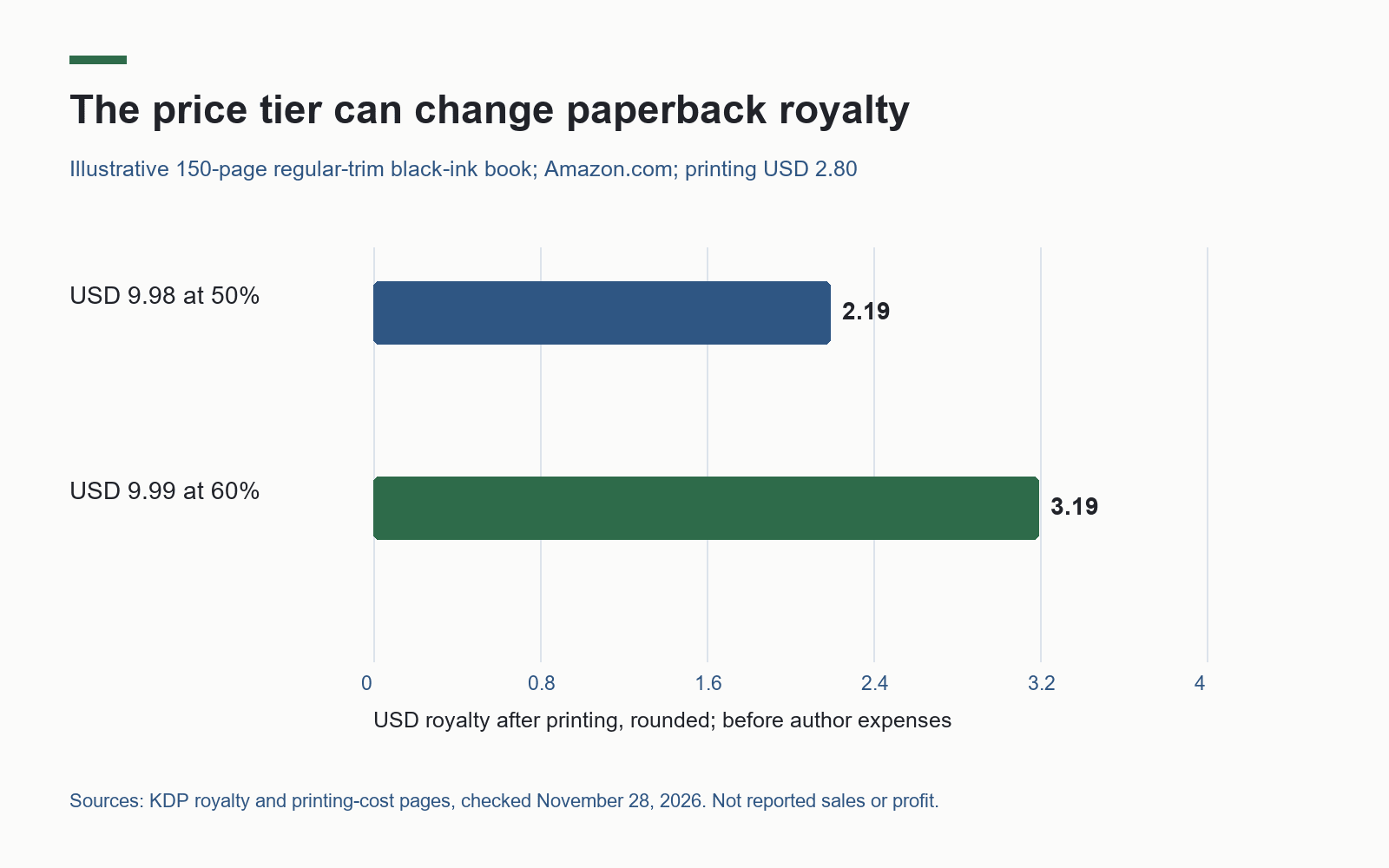
The threshold changes the arithmetic, but it does not tell you what the audience will pay. Price must still fit the book’s value and competitive context. Do not infer that every price increase improves total earnings.
How do you recover editing and design costs?
Divide the cost you intend to recover by the applicable contribution from a sale, using a consistently defined amount. If advertising or other per-sale costs apply, subtract them before calculating recovery.
Hypothetical author-cost model: assume USD 300 setup cost and USD 3 contribution per sale after the variable costs included in your model. One hundred sales would cover that setup cost. This is a required quantity under invented inputs, not a sales forecast. It excludes labour, tax and any costs not included.
If the needed volume has no evidence behind it, lower the commitment or improve the offer before spending. A print-on-demand process removes the need to hold a warehouse of books; it does not remove the risk of paying for a book nobody wants.
Should you publish an ebook too?
Choose the format from the reading task. A portable text guide may work well digitally; a workbook may benefit from physical writing space. Our Kindle ebook versus paperback comparison separates the format and cost choices.
If AI tools are involved, read the KDP AI-content rules. Disclosure and quality are separate from the royalty calculation.
For an audience-building plan, compare blog and newsletter publishing before assuming a book listing will supply all discovery.
Our recommendation: calculate the exact finished specification, inspect a real proof and keep author profit separate from the platform royalty.
Frequently asked questions
Does a 60% royalty mean I keep 60% as profit?
No. Printing is deducted in the paperback calculation, and your own publishing, marketing, labour and tax costs remain.
Can a small price change alter the royalty rate?
Yes, KDP lists price thresholds by marketplace. Use the actual threshold and specification for the intended sale.
Can I use one printing quote for every marketplace?
No. Production costs, currency, thresholds and tax treatment can differ. Calculate the intended marketplace separately.
Does the calculator prove a book will sell?
No. It estimates the production economics under your inputs. Demand and reading quality need separate evidence.
Sources
- KDP printing-cost and royalty calculator, checked November 28, 2026.
- paperback royalty page, checked November 28, 2026.
- printing-cost page, checked November 28, 2026.
Information only, not financial, tax or legal advice. Fees and prices change, so check the platform before you act. Disclaimer (opens in a new tab)
Was this article helpful?


Comments