




On this page
Affiliate marketing for beginners works best as a useful recommendation business, not a race to post the most links. Checked November 28, 2026, our recommendation is one audience problem, one permitted program and one original explanation that helps a reader choose. A click is not a commission, and a commission is not profit until content costs and other obligations are counted.
What is affiliate marketing for beginners?
Affiliate marketing means a business rewards a publisher for a qualifying referred action under its program rules. That action might be an approved sale rather than a visit. The merchant defines the qualifying products, attribution conditions, exclusions and payment process.
The publisher supplies the explanation and the relationship with the reader. You should be able to explain why a product suits the task, where it falls short and when a reader should keep their money. A recommendation that remains useful without its affiliate link is a stronger starting point.
This guide uses public program documentation and editorial planning examples. We are not reporting affiliate earnings or claiming to have tested products we have not used.
What do you need before joining a program?
You need a legitimate publishing destination, accurate account details, a supported payment route and a topic you understand. A simple website or permitted social presence can be enough to investigate a program, but the program decides which destinations it accepts.
Start with tools you already have. Budget research, production and maintenance time before buying subscriptions or advertising. If a product requires hands-on evaluation, allow for a real sample; a generated picture cannot establish that you used it.
Amazon’s Associates policies illustrate why reading terms matters: qualifying revenue and purchases have specific definitions, and cancelled or refunded purchases can be excluded. Other programs use different conditions.
How do you build a first affiliate article?
Build around a decision the reader already needs to make, then choose a suitable program. Reversing that order often produces an article that exists only because a commission is available.
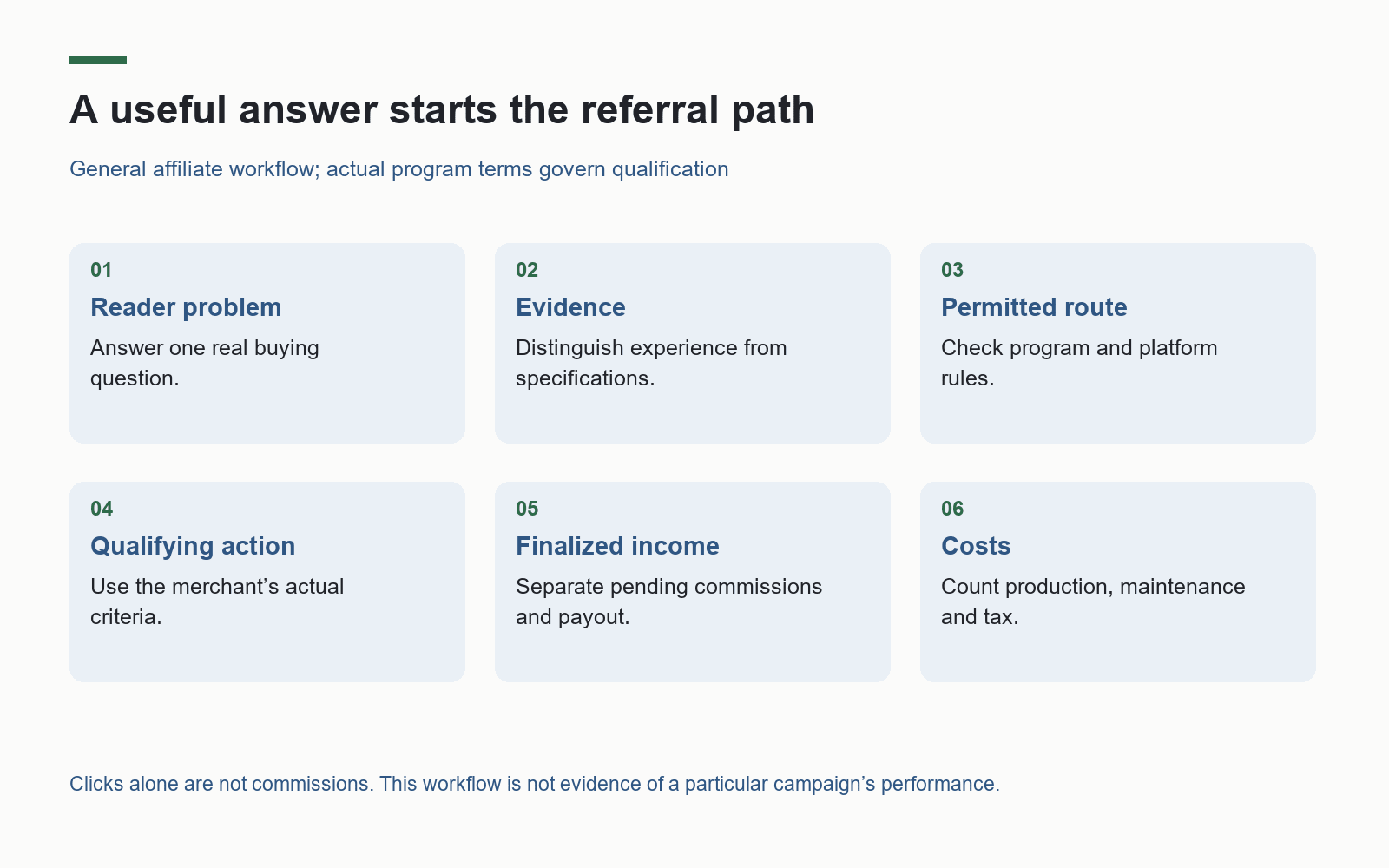
- Choose a narrow buying question. Identify the reader, intended use and constraint. A comparison for a small recording space is more useful than an unexplained list of expensive microphones.
- Check the program and publishing rules. Read acceptance criteria, approved destinations, attribution, prohibited promotion and payment requirements. Save the date and the version you rely on.
- Gather honest evidence. Use actual experience where available and distinguish it from specifications supplied by the manufacturer. Do not write a first-hand review from a product page.
- Write the recommendation and its limits. Explain the selection criteria, the suitable buyer and the reason to choose an alternative. Include relevant costs beyond the initial purchase.
- Disclose the relationship clearly. Place the explanation where readers encounter the recommendation. Use the wording and placement required by applicable rules and the program.
- Check the destination and record outcomes. Verify the correct product, availability and permitted link behavior. Track finalized commissions separately from clicks and pending orders.
Tip: Keep a simple source log for specifications, actual tests, program terms and the last link check. It makes a useful article easier to maintain.
How much can affiliate content earn?
There is no reliable universal income figure. Earnings depend on suitable readers, qualifying actions, the actual program rate and the cost of producing and maintaining the content. A large audience with little buying intent can earn less than a small relevant one.
Hypothetical planning example, not a program quote: assume 200 tracked product visits, ten qualifying orders averaging USD 40 and an assumed 4% commission. Qualifying revenue is USD 400 and commission is USD 16. At USD 25 cash content cost, the example has a USD 9 shortfall before labour and tax. None of these assumptions is a traffic or conversion benchmark.
A negative first result is not a reason to buy more traffic automatically. Inspect whether the question, recommendation and destination fit. If the offer cannot recover content cost under reasonable observed conditions, change the offer or stop.
Where should you publish the recommendation?
Choose the destination where you can answer the question well and follow the rules. A blog can hold a detailed comparison; a newsletter can serve readers who explicitly asked for ongoing recommendations. Our blog versus newsletter comparison explains the workload and discovery trade-offs.
For visual topics, Pinterest affiliate marketing can support a useful discovery path, subject to both platform and program requirements. Do not assume an affiliate link is allowed everywhere just because you received it.
Avoid bought lists, copied product descriptions, fake urgency and unsupported discount claims. A disclosure does not repair an inaccurate recommendation.
What legal and payment checks matter?
Check the rules for the audience and business arrangement you actually serve. The FTC’s endorsement guidance explains material-connection disclosure for US-facing endorsements. Other jurisdictions may impose different requirements. This is general information, not individual legal or tax advice.
Keep payment records, costs and adjustments. Confirm whether income is pending, approved or paid, and budget any currency or withdrawal charges from your actual provider. A screenshot from another publisher cannot establish your own proceeds.
Our recommendation: publish one useful, maintainable explanation first. Use paid versus free newsletters to compare the reader promise before adding another income model.
Frequently asked questions
Do I need a large audience for affiliate marketing?
A relevant audience and useful content matter more than a headline count. Each program has its own acceptance requirements, and none guarantees sales.
Can I call a product a review without using it?
Do not imply first-hand testing. A clearly labelled specification comparison is different from a hands-on review.
Does every click earn a commission?
No. Read the qualifying-action, attribution and exclusion rules for the actual program.
Should I pay for ads immediately?
Start by verifying the offer and program permissions. Paid traffic adds a cost that commissions must recover.
Sources
- Associates policies, checked November 28, 2026.
- FTC’s endorsement guidance, checked November 28, 2026.
Information only, not financial, tax or legal advice. Fees and prices change, so check the platform before you act. Disclaimer (opens in a new tab)
Was this article helpful?



Comments