




On this page
Paid vs free newsletter is a decision about the reader promise, not a test of whether you deserve support. Checked November 28, 2026, our recommendation is to start free while you establish a useful repeatable edition, then charge for a clearly defined additional result when demand is visible. A public audience count alone does not establish willingness to pay.
How does paid vs free newsletter publishing compare?
A free edition reduces the purchase barrier but still costs time and money to produce. A paid edition adds a recurring customer relationship and a delivery obligation. Neither model is automatically more profitable.
| Decision | Free edition | Paid edition |
|---|---|---|
| Our first-use pick | Proving a useful, sustainable publication | A validated recurring benefit readers want to buy |
| Main reader commitment | Attention and a permitted subscription | Attention, payment and continuing expectations |
| Potential funding | Relevant sponsors, offers or optional support | Subscription receipts, subject to deductions |
| Main workload risk | Producing indefinitely without a funding plan | Overpromising benefits or personal access |
| Evidence to seek | Useful replies, return engagement and retention | Real paid demand and benefits delivered reliably |
This is an editorial decision framework, not a report of conversion rates from a publication we operate.
What makes a newsletter worth paying for?
A paid edition needs a specific benefit that remains valuable across billing periods. That might be original analysis for a narrow professional task, a dependable research digest or a carefully prepared practical briefing.
Explain what is included, how often it arrives and who should skip it. A reader should know whether they are buying information, access, participation or personal work. Those promises have different costs.
Avoid charging for an undefined claim of “more value.” Describe an actual edition or benefit so a reader can decide before purchase. If the offer depends on specialist expertise, demonstrate it accurately rather than borrowing an authoritative tone.
When should the edition remain free?
Keep it free when you are still discovering the audience’s recurring need or proving you can publish consistently. The free phase should be an intentional experiment with a review point, rather than an endless obligation with no cost record.
Free can also be the permanent model when suitable commercial offers cover the work without undermining the editorial promise. A sponsor must fit the audience and should not buy unsupported praise. Our newsletter sponsorship pricing guide explains the scope and reporting questions.
Optional Tip Jar support is another arrangement where available. Do not include assumed tips in the minimum budget before observing them.
What costs change when readers pay?
Payment processing, platform deductions, refunds, billing questions and customer support can add costs. Readers may also expect stronger consistency, a useful archive and a clear response when an edition is delayed.
Substack’s cost page separates its platform share from payment and billing charges. beehiiv’s pricing page instead places paid subscriptions within paid plans. Compare the actual route, not just the label “paid newsletter.”
You can keep a free edition alongside paid work, but that adds editorial planning. Decide which promise belongs to each. Repeatedly publishing only a fragment and then withholding the answer can weaken the usefulness of the free version.
How can you test the paid idea honestly?
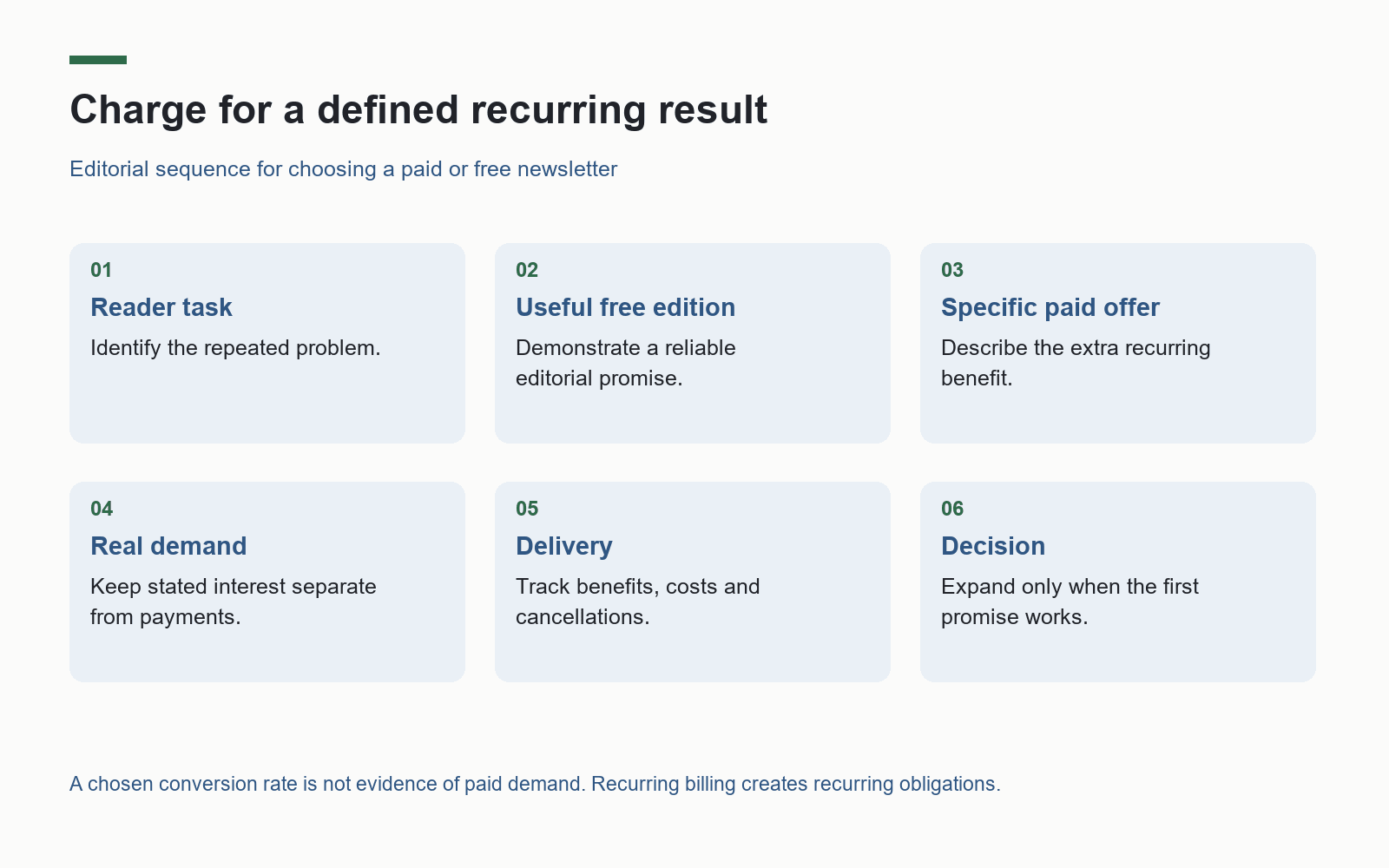
Describe a concrete proposed offer to the existing audience and ask about the problem it would solve. Keep stated interest separate from paid demand. A person saying an idea sounds good has not agreed to an ongoing charge.
If you launch a paid pilot, clearly state its period, benefits, delivery assumptions, cancellation route and what happens afterward. Use the platform’s supported checkout and local requirements. Do not fabricate subscribers, reviews or scarcity to create momentum.
Budget a small version that works for the earliest paying readers. An offer that becomes useful only after a large group joins needs a clear minimum-participation plan before you accept payments.
How should you model break-even?
Use actual net proceeds per active payer after the relevant deductions, then compare them with the recurring cost of delivering the offer. Keep the same reporting period throughout.
Hypothetical monthly offer: assume USD 7 net proceeds per active payer after transaction deductions, USD 1 variable delivery cost and USD 180 fixed editorial cost. Contribution is USD 6 per payer, so 30 active payers cover the USD 180 cost. This excludes any labour, tax or acquisition cost not included in those inputs and does not predict that 30 readers will subscribe.
A break-even point is a requirement to meet, not market evidence. If reaching it would need a large unsupported jump from current interest, reduce the commitment or improve the offer before launching.
What should you track after launch?
Track benefits delivered, active paying accounts, cancellations, refunds, support time and retained proceeds. Ask what readers used, not only whether they enjoyed the edition. A benefit can be pleasant but too weak to justify the next payment.
Do not hide cancellation or treat a departing reader as a failed supporter. A clear exit protects trust and gives you more interpretable feedback about the offer.
Read Substack versus beehiiv when the platform’s cost structure becomes a material decision, and use newsletter niche ideas if the audience problem is still too broad.
Which one should you choose?
Choose free if you are validating the editorial promise or have a credible funding model that does not require recurring reader payments.
Choose paid if readers want a specific recurring benefit and you can deliver it after costs, through a supported payment route.
Our default pick: establish a reliable free edition first, then test a bounded paid offer using actual demand and delivery evidence. Add complexity only after the first promise works.
Frequently asked questions
How many subscribers do I need before charging?
There is no reliable universal threshold. Specific paid demand, delivery capacity and net proceeds matter more than a headline audience count.
Can a free newsletter earn money?
It may use relevant sponsors, offers or optional support. Each route needs suitable demand and must cover the work and costs.
Should all useful content go behind the paywall?
Keep the free promise useful. Define what the paid offer adds rather than making the free version an incomplete teaser.
Does recurring billing make the work passive?
No. A recurring benefit creates ongoing editorial, support and administration obligations.
Sources
- cost page, checked November 28, 2026.
- pricing page, checked November 28, 2026.
Information only, not financial, tax or legal advice. Fees and prices change, so check the platform before you act. Disclaimer (opens in a new tab)
Was this article helpful?



Comments