




On this page
Pinterest affiliate marketing should connect an original useful Pin with an honest, permitted recommendation. Checked November 28, 2026, our recommendation is to begin with one audience task and a trustworthy destination, then verify both Pinterest’s rules and the affiliate program’s permissions. Avoid treating saves, impressions or a large volume of links as evidence of commission income.
What does Pinterest affiliate marketing involve?
It uses visual discovery to introduce content or a product recommendation that may produce a qualifying affiliate action. The commercial relationship must be clear, and the destination must deliver what the Pin promises.
Pinterest’s commercial-content guidelines allow affiliate content subject to rules including originality, transparency and avoiding spam or artificial traffic manipulation. They do not override the merchant’s separate program conditions.
This is a practical publishing workflow based on those public rules. We have not run an account-level campaign or measured affiliate results.
What do you need before creating a Pin?
You need original visuals or appropriate permissions, an accurate recommendation and a program that permits your intended route. If the destination is your own article, make sure it is complete and usable on a phone before promoting it.
Use design and publishing tools you already understand. Allow time for research, a real demonstration where needed, visual creation, destination checks and maintenance. Paid traffic or a paid design subscription is not required to establish whether the editorial idea is useful.
Choose an actual reader task: comparing two suitable materials, planning a small space or completing a craft process. A product list with no decision criteria gives the visitor little reason to trust the link.
How do you build a useful affiliate Pin?
Create the recommendation before the promotion. This prevents a polished image from sending readers into thin or inaccurate content.
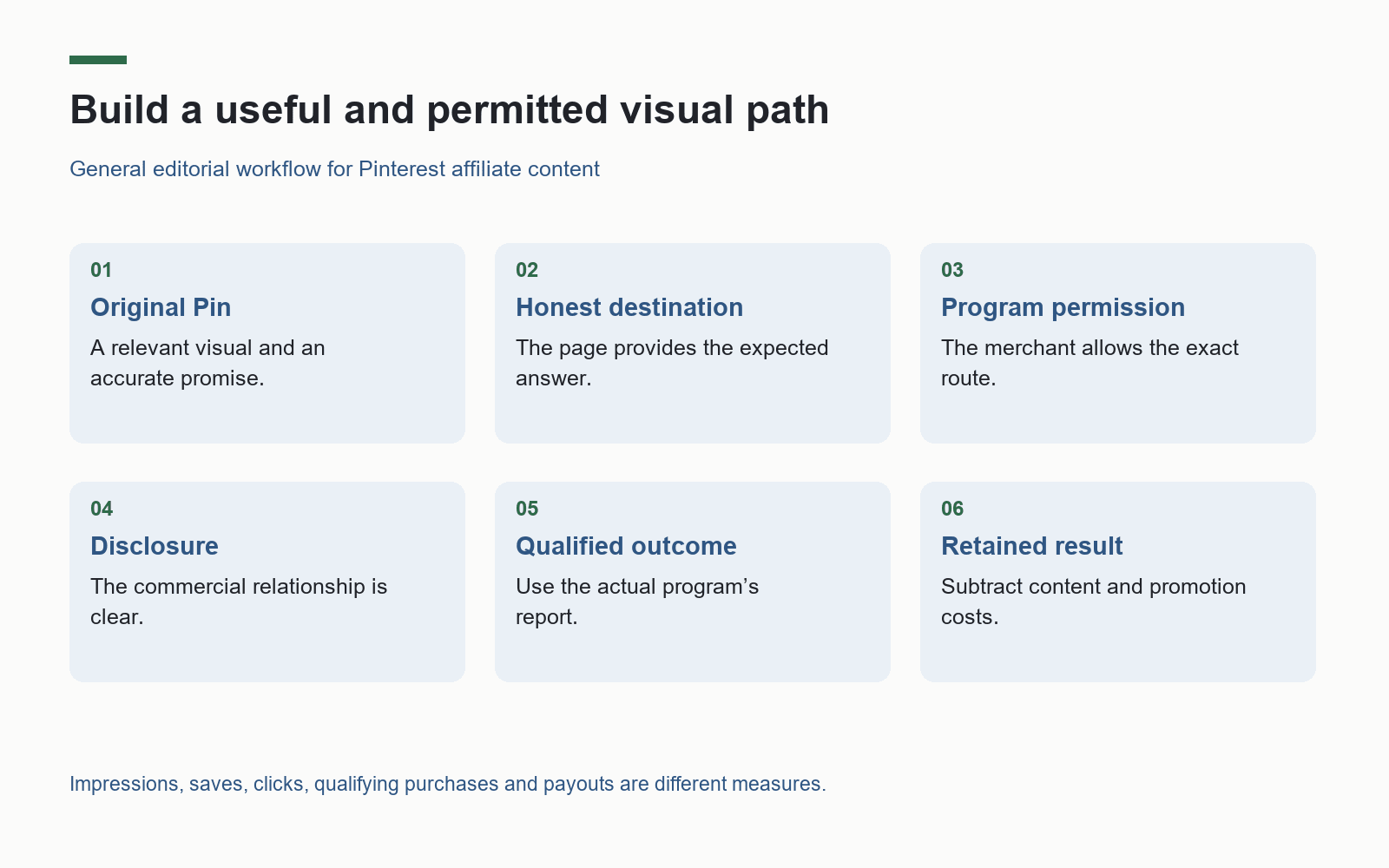
- Choose one audience question. Define the intended reader and the decision. Narrow the topic enough that you can provide useful evidence and limitations.
- Check both sets of rules. Confirm the affiliate program accepts the destination, link behavior and promotion method. Read Pinterest’s current commercial rules before choosing a publishing pattern.
- Prepare the destination. Give the answer, disclose the relationship and make the relevant next step clear. If you discuss a product you have not used, distinguish documentation from experience.
- Create an original visual. Show the actual useful result or an honest editorial concept. Avoid copying another creator’s project or using a generated scene as evidence of product quality.
- Describe the destination accurately. Keep the Pin’s promise, availability and material claims consistent with the page. Use clear commercial disclosure appropriate to the context and applicable rules.
- Check the path and measure qualifying outcomes. Verify the mobile destination, permitted tracking and program report. Separate discovery metrics from approved commissions and actual payout.
Tip: Keep one record connecting the Pin, destination, product, disclosure and last link check. A change at the merchant can make an otherwise useful Pin misleading.
Should you link directly to a product or to an article?
Choose the route that the program permits and the reader’s task needs. A direct link may suit a straightforward product discovery, while a comparison or explanation can require an intermediate article. Do not add an unnecessary page solely to create extra clicks.
For a detailed buying decision, our affiliate marketing guide explains the evidence and limitations a useful recommendation should include. For a publication strategy, compare blog and newsletter roles.
Check the supported link format. Pinterest’s affiliate guidelines warn that some shortening services are unsupported and call for transparency about link behavior. An obscured destination can also violate a merchant’s terms.
What should you measure?
Measure whether the Pin attracts the right person and whether the destination helps them complete the task. Impressions show exposure; saves can indicate interest; an outbound visit is still not an approved sale.
Hypothetical campaign arithmetic: assume USD 45 total content cost and USD 18 approved commission after the merchant’s adjustments. The campaign is USD 27 short of its cash content cost before labour and tax. Even a large impression count would not erase that shortfall. These invented values are not Pinterest or affiliate benchmarks.
Use your own report periods and attribution rules. Do not combine one month’s content cost with an unrelated period’s sales to manufacture an attractive return.
How do current shopping tools affect the opportunity?
New discovery and comparison tools can change the reader’s path, but they do not guarantee that your content will be selected or paid. Keep product information accurate and make the recommendation useful even when the visitor arrives without the original Pin context.
Pinterest’s Creators to Watch spotlight emphasizes original expertise. It is not a payout scheme. Likewise, the Microsoft Advertising integration is an advertiser-distribution change, not a new affiliate commission program.
What should you avoid?
Avoid repetitive mass posting, fake accounts, reciprocal saving schemes and unsupported claims. Keep commercial content relevant to the board and the audience. A disclosure cannot make copied or misleading work acceptable.
For legal details, consult the applicable authorities or a qualified professional. The FTC’s disclosure guidance is one official US-facing reference; other jurisdictions can require different steps. This article provides general information.
Our recommendation: publish one original useful path, inspect the real outcome and improve the destination before scaling volume or spending.
Frequently asked questions
Are affiliate links allowed on Pinterest?
Pinterest permits affiliate content subject to its commercial and spam rules. The affiliate program must separately permit your exact promotion route.
Do saves or impressions earn commissions?
Not by themselves. The merchant’s qualifying-action and attribution rules determine affiliate earnings.
Do I need a blog?
Use a blog when the reader needs an explanation or comparison. Direct linking depends on the permitted program and whether it serves the task.
Should I publish many similar Pins at once?
Avoid repetitive high-volume affiliate posting. Start with original useful content and follow the platform’s current rules.
Sources
- commercial-content guidelines, checked November 28, 2026.
- FTC’s disclosure guidance, checked November 28, 2026.
Information only, not financial, tax or legal advice. Fees and prices change, so check the platform before you act. Disclaimer (opens in a new tab)
Was this article helpful?



Comments