




On this page
Newsletter sponsorship pricing should define what the advertiser buys and what the publisher can verify. Checked November 28, 2026, our recommendation is a bounded placement with clear creative limits, reporting and payment terms. Build a cost floor before discussing a rate, and never present total subscribers or recorded opens as guaranteed human exposure or sales.
What do you need before pricing a sponsorship?
You need a useful publication, accurate audience evidence, an appropriate advertiser and a defined placement. Prepare an example edition, a concise description of the audience and dated reports you are allowed to share.
Budget time for prospect research, negotiation, creative review, scheduling, billing and reporting. Those activities are part of the campaign even if the ad itself occupies only a short section of the email.
This guide uses an editorial workflow and explicit hypothetical arithmetic. We have not sold the placements described or measured sponsor results.
How do you build newsletter sponsorship pricing?
Price the actual deliverable rather than applying an unexplained multiplier to your list size. The sponsor’s relevant audience and objective matter alongside the work and risk you accept.
- Define the campaign objective. Agree whether the advertiser wants relevant exposure, visits, qualified inquiries or another measurable outcome. Do not promise sales you cannot control.
- Define the placement. State the edition, position, format, link allowance, exclusivity if any and whether the work also appears in an archive. Keep additional social promotion separate unless included.
- Agree on the creative process. Specify who supplies the copy, the claim evidence required, revision limits and the approval deadline. Retain the right to decline unsupported claims.
- Choose a measurement basis. Name the metric, time window, tracking limitations and any exclusions. If the fee depends on delivery, define what delivery means and how it is reconciled.
- Calculate the complete cost floor. Include sales work, editing, administration, reporting, payment charges and any agreed make-good obligation.
- Document payment and post-campaign reporting. Identify the contracting party, invoice timing, due date, cancellation conditions and the report you will deliver.
Tip: Put the metric definition in the proposal itself. “Reach” and “engagement” are too vague when money or a replacement placement depends on them.
Should you charge a fixed placement fee or CPM?
A fixed fee can be simpler when you sell a clearly described edition placement. CPM means cost per thousand of an explicitly defined measure; it is useful only when both sides agree on that denominator.
Do not apply a CPM to total subscribers if the contract concerns delivered messages, or to recorded opens if the advertiser believes they are verified readers. Apple’s privacy documentation explains why email opening cannot always be inferred reliably.
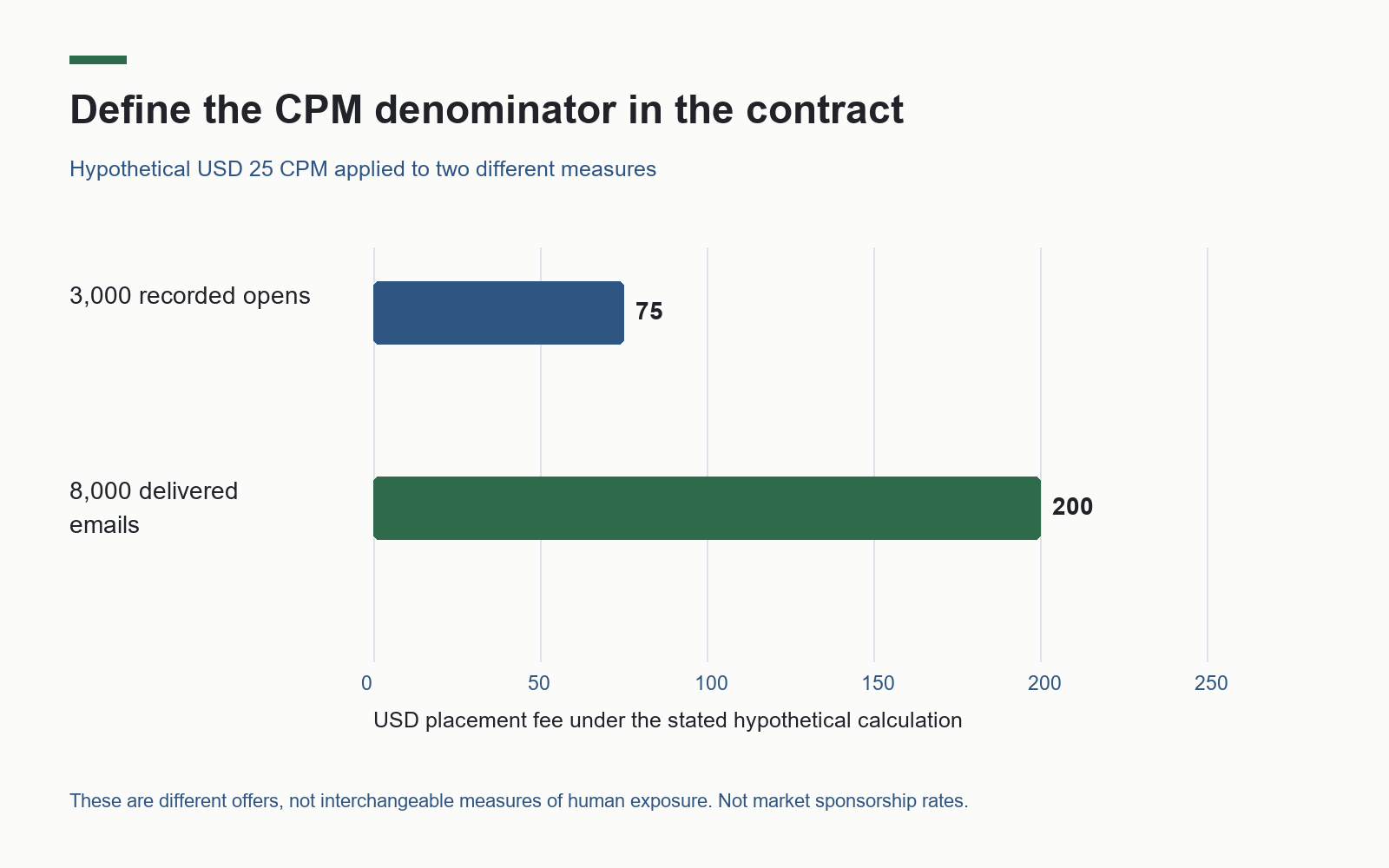
Hypothetical pricing exercise: an assumed USD 25 CPM on 8,000 contract-defined delivered messages produces a USD 200 placement fee. If the same USD 25 is instead applied to 3,000 recorded opens, the arithmetic is USD 75. These are invented rates and counts, not market benchmarks. The two results use different denominators and should not be advertised as the same offer.
How do you calculate what the campaign leaves?
Subtract cash campaign costs from the fee, then account for all time and remaining obligations. A paid placement can appear attractive when the publisher ignores the effort needed to find and serve the advertiser.
Hypothetical work example: take the USD 200 fee above, assume USD 20 cash costs and six total hours across sales, creative review and reporting. USD 180 remains before tax and other overhead, equivalent to USD 30 per hour before those omitted costs. These inputs are not expected sponsor pay or evidence that a campaign will sell.
Use your own completed campaign record to improve the next quote. If sponsors require extensive revisions or highly customized reporting, that work belongs in the scope rather than being absorbed indefinitely.
What should a sponsor report include?
Include the contracted placement, publication date, agreed measurement window and actual results using the definitions in the proposal. Explain known limitations and distinguish a publisher click from the advertiser’s independently measured conversion.
Avoid identifying individual readers unless a lawful, disclosed and appropriate arrangement genuinely requires it. A sponsor usually needs campaign evidence, not your subscriber database.
Keep a copy of the approved creative and any correction. If a placement failed to meet an agreed condition, follow the documented remedy rather than inventing a new rule after delivery.
What disclosure and claims checks matter?
Make the commercial nature clear. The FTC’s endorsement guidance covers material relationships in US-facing endorsements. Other jurisdictions can impose additional requirements; this is general information rather than individual legal advice.
A sponsor’s payment is not evidence that its claims are true. Ask for support for factual claims, avoid implying personal use you have not had and decline unsuitable products. Protecting the publication’s trust is part of the commercial decision.
When should you choose another model?
Choose another model when the audience is too undefined to describe credibly, the advertiser is a poor fit or the operational burden outweighs the fee. Compare paid versus free newsletters and affiliate recommendations as different arrangements with different responsibilities.
Use deliverability checks before promising a send, and consider beehiiv podcast ads separately if you also publish audio. A podcast download and an email delivery are different inventory units.
Our recommendation: sell one clearly defined placement, learn from the full workload and report honestly. Raise complexity only when you can price and fulfil it.
Frequently asked questions
What is a good newsletter sponsorship rate?
There is no universal rate. Define audience fit, placement, measurement, work and risk, then compare the proposed fee with your cost floor.
Can I charge CPM on my subscriber count?
Only if that is explicitly the contracted measure. Do not imply it represents delivered messages or verified readers.
Should I guarantee sales?
Do not promise an outcome outside your control. Agree on a suitable objective and report the evidence you can actually verify.
Does the sponsor need my subscriber list?
A normal campaign report can usually use aggregate evidence. Do not casually share reader-level information as part of an ad deal.
Sources
- Apple’s privacy documentation, checked November 28, 2026.
- FTC’s endorsement guidance, checked November 28, 2026.
Information only, not financial, tax or legal advice. Fees and prices change, so check the platform before you act. Disclaimer (opens in a new tab)
Was this article helpful?



Comments