




On this page
Kindle ebook vs paperback should start with how the reader will use the book. Checked November 28, 2026, our default for a first text-led reference is an ebook, while a workbook or visually physical reading task may justify paperback first. Compare formatting, delivery and complete author costs before treating the higher royalty per unit as the better business.
How does Kindle ebook vs paperback compare?
The ebook avoids a printed unit, but still requires editing, usable formatting and a supported reading experience. Paperback adds a production specification, physical proof and a printed object the reader may value.
| Decision | Kindle ebook | Paperback |
|---|---|---|
| Our first-use pick | Text-led reference read on supported devices | A task that benefits from a physical book |
| Production checks | Navigation, reflow or fixed layout, images and device preview | Trim, pagination, print quality, margins and binding |
| Variable-cost question | Applicable royalty option and delivery conditions | Applicable rate minus printing cost |
| Main reader limitation | The device or format may not suit the activity | Physical delivery and a fixed printed version |
| What does not change | Originality, accuracy and a useful complete book | The same editorial quality obligation |
This comparison is based on KDP’s public rules and editorial planning. We have not published or physically tested the example editions.
Which format suits the reader’s task?
Choose an ebook when convenient digital reading, navigation and portability serve the material. A concise original reference can work without a physical object if the layout remains usable on the intended devices.
Choose paperback when handling, annotation or writing space is central to the activity. A workbook with generous spaces may lose much of its purpose in an unsuitable digital format. A visually complex book also needs careful format testing rather than an automatic conversion.
Avoid assuming one uploaded file creates two equally good editions. An ebook’s reading behavior and a printed page’s fixed geometry need different quality checks.
How do royalty calculations differ?
KDP’s ebook royalty guidance describes 35% and 70% options with conditions including eligible territories and delivery costs. Its explicit 70% calculation example applies the rate after applicable VAT and delivery deductions. Use the actual book’s terms and price requirements.
Paperback uses the applicable rate multiplied by list price, less printing, according to KDP’s paperback guidance. Our paperback royalty guide shows the production and price-threshold checks.
The percentages apply to different economics. A rate comparison alone ignores the customer price, unit costs, author expenses and the reader’s willingness to buy the format.
What does an illustrative comparison show?
An example can show the calculation structure, but it cannot establish the best price or expected demand. Keep the manuscript and assumptions visible so the result can be replaced with your own quote.
Hypothetical format model, not a book’s reported earnings: assume an eligible ebook at USD 4.99, no applicable VAT in this scenario and an assumed USD 0.10 delivery cost. Applying 70% to USD 4.89 gives about USD 3.42. Assume a paperback at USD 12.99, a 60% rate and USD 2.80 printing: the result is about USD 4.99. Eligibility, price rules, costs and rounding must be checked for the actual book. Author expenses and tax are excluded.
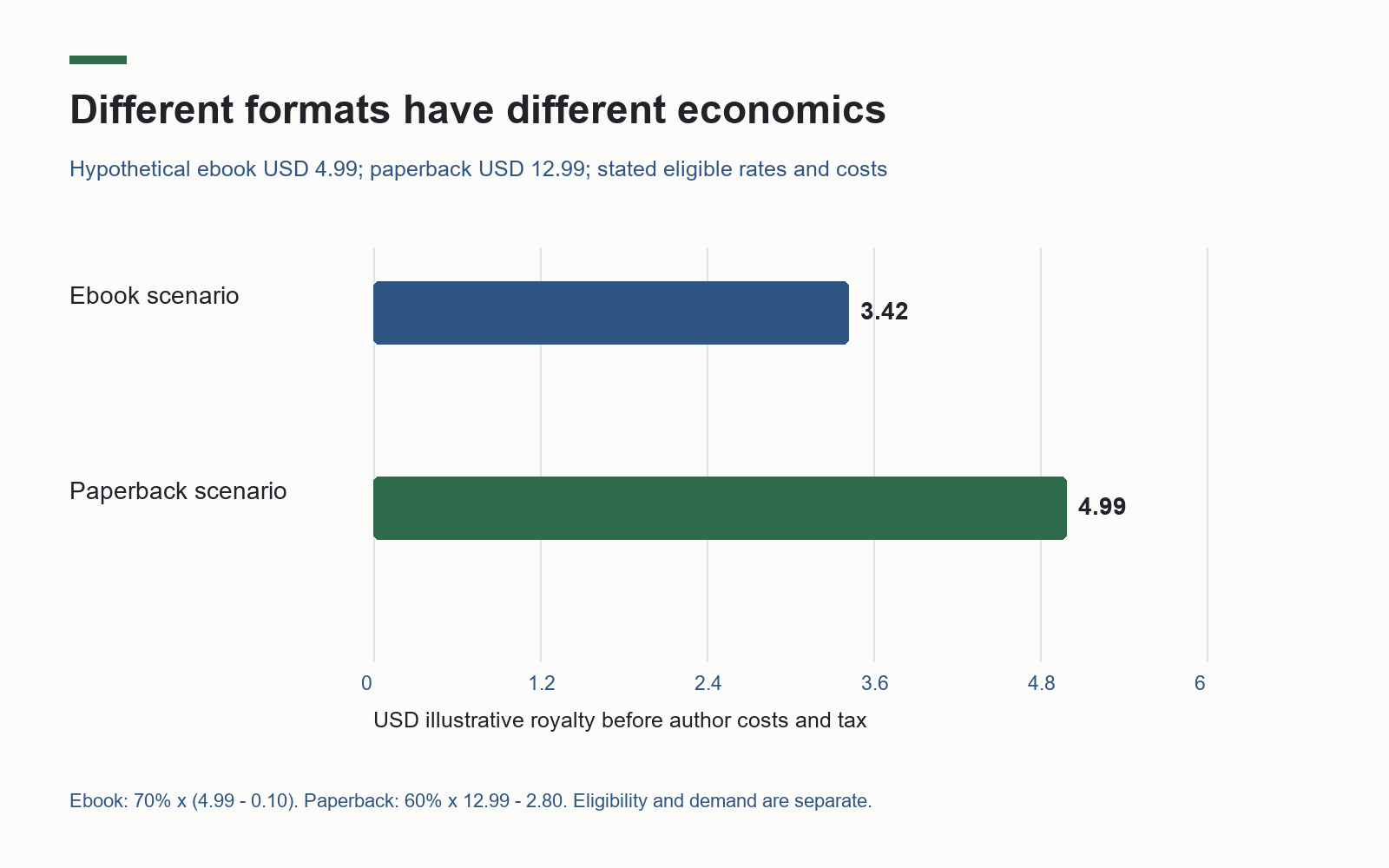
A higher unit result can still be the weaker choice if the format takes much longer to create or serves the audience poorly. Include the effort needed for both editions, not only the cost to export the file.
Which preparation costs should you count?
Count editing, fact checking, rights clearance, illustrations, cover design, formatting, previews, proofs and revisions. Some work is shared, while format-specific preparation is additional.
Keep a clean master manuscript and record which version produced each edition. An error corrected in the ebook can remain in the print file if the workflow has no version control.
When AI tools contribute actual content, review the KDP AI-content rules. A disclosure does not establish accuracy, permission or a good reading experience.
Should you launch both at once?
Launch both only if each version is complete, useful and properly checked. Otherwise, prioritize the format that best serves the first audience and add the second after validating the offer.
For a small project, simultaneous editions can divide attention across more formatting and support questions. A carefully checked single edition can provide better evidence than two rushed versions.
Decide how changes will be maintained. A time-sensitive guide needs an update plan, especially when physical copies remain in circulation after a digital correction.
How should you reach readers?
Use a specific audience problem and an honest description of the finished book. An ebook listing is not a complete discovery strategy. A helpful blog or newsletter can demonstrate expertise, but its readers still need a genuine reason to want the book.
Do not manufacture reviews or claim sales results you have not achieved. A useful sample of the book and a precise description are stronger than unsupported bestseller language.
Which one should you choose?
Choose Kindle ebook if the material is text-led and the intended reading task works well digitally. Test the actual navigation and layout on suitable previews.
Choose paperback if the physical format adds practical value that justifies printing, proofing and delivery. Check the finished object rather than judging a cover mockup alone.
Our default pick: complete the ebook first for a digital reference, or paperback first for a physical workbook. Add the other format when it serves the same reader well and its extra preparation is justified.
Frequently asked questions
Do ebooks always make more profit?
No. Compare the actual royalty conditions, preparation costs, price and demand for the format. Avoid judging by the headline rate alone.
Can I use the same layout for both?
The same manuscript can supply both, but digital navigation and fixed printed pages need their own formatting checks.
Should a workbook be an ebook?
Choose the format that supports the activity. If writing space or physical handling is central, paperback may be the better first edition.
Do I need to launch both editions together?
No. Publish a complete checked edition first when that is the manageable way to serve the reader and validate demand.
Sources
- ebook royalty guidance, checked November 28, 2026.
- paperback guidance, checked November 28, 2026.
Information only, not financial, tax or legal advice. Fees and prices change, so check the platform before you act. Disclaimer (opens in a new tab)
Was this article helpful?



Comments