




On this page
Substack vs beehiiv is mainly a choice between a percentage-based paid-publication model and a plan-based publishing toolkit. Checked November 28, 2026, our recommendation is Substack for a writer testing a straightforward paid publication without a fixed platform subscription, and beehiiv when a measured publishing operation justifies its plan cost. Compare the complete payment route and renewal commitment before switching.
How does Substack vs beehiiv compare?
Substack’s cost documentation says publishing is free and its platform takes 10% when paid subscriptions are enabled, with Stripe charges separate. beehiiv’s current pricing page lists Free, Lite, Pro and Enterprise, with paid subscriptions on Lite and above and a 0% platform take rate on those subscriptions. Neither statement means every business or payment cost disappears.
This comparison is based on official pages, not a first-hand migration or a test of acquisition performance. We do not assign a monetary value to either platform’s discovery features without your own evidence.
| Decision | Substack | beehiiv |
|---|---|---|
| Our first-use pick | Testing a straightforward writer-led publication | A publishing operation with specific toolkit requirements |
| Platform cost structure | Share of paid subscription revenue | Plan and subscriber-tier commitment |
| Payment costs | Separate processing and applicable billing costs | Check the actual connected payment route |
| What to validate first | Readers will pay for the publication | Features and avoided revenue share justify the plan |
| Main planning risk | Percentage cost increases with paid revenue | Fixed subscription cost continues through weaker months |
Which cost should you compare first?
Compare platform cost for the same paid revenue and billing period, then add the remaining deductions. A free publishing account and a paid monetization plan are not equivalent products merely because both can send emails.
At the displayed 1,000-subscriber setting, beehiiv’s pricing page shows Lite at USD 49 per month with yearly billing. That is an annual commitment expressed as a monthly amount, not evidence of a cancellable monthly price. Subscriber tier, tax and the checkout offer can change the bill.
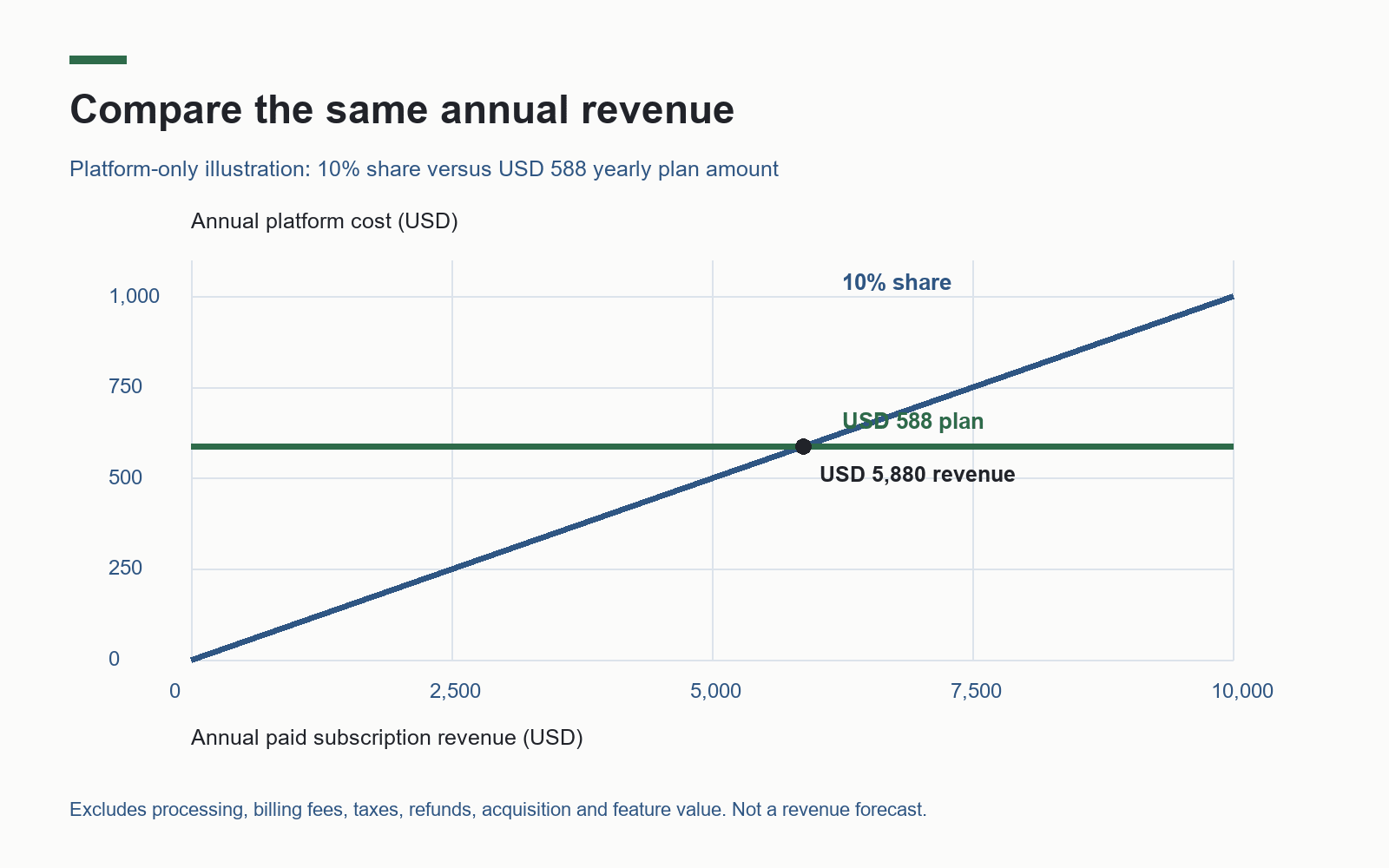
Illustrative platform-only calculation: at the stated USD 49 monthly equivalent, the annual amount is USD 588. A 10% platform share reaches the same amount at USD 5,880 annual paid subscription revenue. This comparison excludes payment processing, billing fees, tax, refunds, growth costs and feature differences. It does not prove either platform will bring that revenue.
Use the actual account quote, not the smallest advertised tier, when your list is larger. Read our beehiiv pricing update for the plan change and renewal dates.
What happens when revenue is uneven?
A percentage model can cost less during a low-revenue experiment because the platform share falls with eligible revenue. A fixed plan needs funding even when no one upgrades that month. The trade-off changes when paid revenue grows, but a spreadsheet crossing point is not a demand forecast.
Look at an ordinary weak month and an annual commitment, not only a successful launch. Keep the marketing and editorial workload visible. Moving to a cheaper fee structure does little if the move interrupts delivery or requires tools that cost more elsewhere.
Which publishing workflow suits you?
Choose a workflow that supports your actual offer. A writer sending a clear recurring essay has different needs from a team managing segmented editions, advertising, audio and a website.
List the tasks you perform now and the features that would remove specific work. Avoid pricing imaginary future complexity into the first platform decision. A feature that might be useful someday is not yet a saving.
Test an ordinary edition, a correction, an unsubscribe and the permitted export process before committing to a migration. Use a test audience that consented to the exercise. Do not import purchased contacts or silently resubscribe people who opted out.
Our email deliverability guide explains the identity and permission checks that matter whichever platform you choose.
What should you check before migrating?
Check what can be exported, what transfers automatically and what needs a separate arrangement. Contact data, content archives, payment relationships, automations and URLs are different assets. Having one export does not prove that every part of the business will move intact.
Build a small migration inventory: sending domain, subscriber status, paid entitlements, archived posts, forms, redirects and analytics baselines. Record what happens to existing subscribers and their billing before taking action.
Keep a backup and a rollback plan appropriate to the permitted process. A change that lowers a fee can still be costly if it creates duplicate charges or prevents a paying reader from receiving the promised work. Get platform support for the details of your own account.
Which one should you choose?
Choose Substack if you are testing a straightforward paid-publication offer and prefer to avoid a fixed platform plan while demand is uncertain. Read the actual processing and billing deductions rather than stopping at the platform share.
Choose beehiiv if the specific tools and your observed paid revenue justify the quoted plan and commitment. Do not upgrade merely because the platform describes a possible earning feature.
Our recommendation: make the first choice around a deliverable publication, then reconsider when actual costs and operational needs change. Use paid versus free newsletters to settle the offer before optimizing its platform bill.
Frequently asked questions
Is Substack free to publish on?
Its official cost page describes free publishing, with a platform share when paid subscriptions are enabled and separate payment charges.
Does a zero platform take rate mean zero cost?
No. Plan costs, processing, tax, refunds and operating expenses can still apply.
Is the displayed beehiiv annual price a monthly contract?
No. A monthly equivalent with yearly billing represents an annual commitment. Use the actual checkout for a monthly offer.
Should I switch as soon as the fee model looks cheaper?
Include migration work, payment continuity, feature differences and subscriber experience before deciding.
Sources
- cost documentation, checked November 28, 2026.
- current pricing page, checked November 28, 2026.
Information only, not financial, tax or legal advice. Fees and prices change, so check the platform before you act. Disclaimer (opens in a new tab)
Was this article helpful?



Comments