




On this page
Price original designs from a clear package and a measured cost floor, then check whether the buyer’s result justifies that price. This second part turns a validated idea into files, usage terms and a quality checklist. We checked the platform and licensing sources on November 25, 2026. A file that costs little to deliver can still be expensive to create and support.
What do you need to price original designs?
You need the brief from part one: validate your idea, a working version of the design and a list of delivery costs. Do not set a permanent price from a competitor’s thumbnail or a platform’s advertised margin.
- Time: Allow a focused packaging session plus a separate usability check by someone unfamiliar with the files.
- Cost: Include required software, licensed assets, samples and test transactions when applicable. Use actual quotes, not an assumed universal budget.
- Tools: Your design software, a folder for buyer-ready exports and a worksheet for costs.
- Output: A tested package, a price floor, a licence summary and an accurate contents list.
| Decision | Record | Acceptance check |
|---|---|---|
| Files | Format, dimensions and version | Every supplied file opens |
| Editing | Required software and editable fields | Buyer knows what can change |
| Usage | Rights you can grant and exclusions | Wording matches input licences |
| Price | Variable costs and desired contribution | Ordinary and adverse cases modelled |
| Support | Included help and custom-work boundary | Common questions answered |
How do you create a buyer-ready package?
Package the result a buyer needs, not every file generated during your design process. The following steps keep the master artwork separate from the customer’s experience.
-
Separate the master from the deliverable
Keep editable source files in your working archive. Create a separate export folder containing only what the customer is entitled to receive. Remove temporary layers, unused alternatives and personal information before preparing the final package.
Choose formats for the buyer’s use case. A finished print, an editable layout and a vector asset have different requirements. State the required software and version compatibility where that matters, and do not promise that a flattened export is fully editable.
-
Test the exact export at the intended size
Open the exported file in the intended reader or application rather than inspecting only the source document. Check dimensions, transparency, font handling, alignment and the final crop. For print products, inspect an appropriate physical sample before making quality claims.
Give each file a meaningful name that identifies its purpose and size. A short start-here document should tell the buyer what to open first and how to recognise the correct file. Avoid making the customer guess between several unexplained versions.

Illustrative studio scene: inspect the customer-ready output separately from the working artwork. -
Write the contents and usage terms
List what the buyer receives, what is editable and what is excluded. State whether a physical item is shipped. Explain the usage permissions you can actually grant, including any limits on redistribution or resale of the source files.
Read the licences of fonts, photographs and library assets before promising commercial or exclusive rights. A design assembled with licensed elements may carry conditions you cannot remove. Keep the applicable licence version with the project record.
-
Calculate a cost floor and stress-test it
Separate percentage deductions from fixed order costs. Include fulfilment, payment costs, platform costs, customer acquisition and a realistic allowance for support or replacements. Decide what contribution is needed to cover creation work, overhead and business profit.
Run an ordinary order and an adverse but plausible order. For POD that could mean an attributed advertising fee or a replacement. For a download it could mean more support time than expected. A product that works only when nothing goes wrong is fragile.
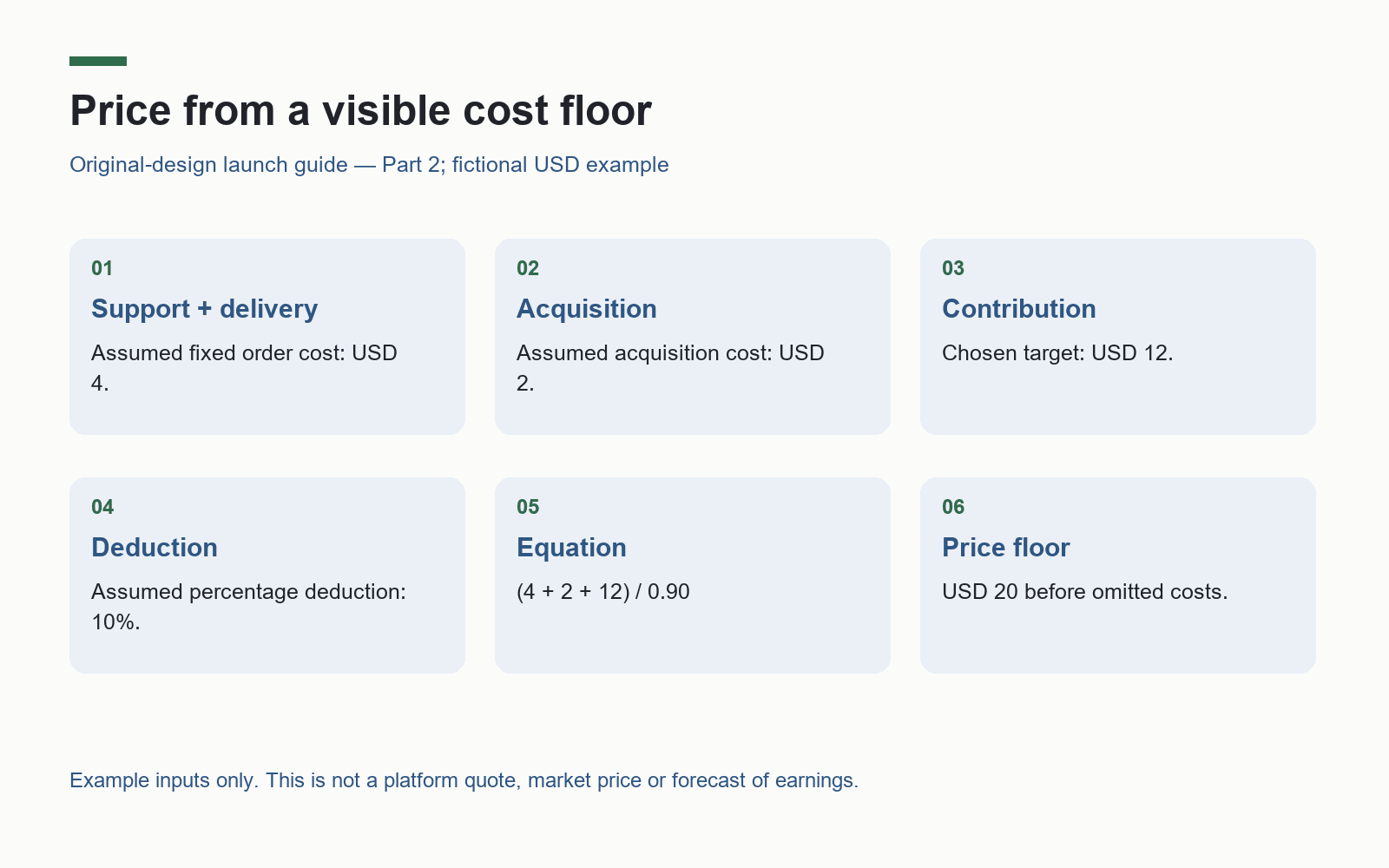
Example inputs only: the price floor must cover variable costs before it can fund the rest of the business. -
Ask a fresh reader to use the package
Give a willing tester the customer package and its instructions, without explaining the missing steps aloud. Ask them to identify the contents, open the right file and perform the first intended action. Record where they hesitate.
Fix confusion in the package or listing. If completing the task requires repeated personal intervention, either simplify the product or price it as a supported service. Save the tested version so the listing and download remain aligned.
What is a reusable pricing equation?
A useful floor divides the amount you need after fixed costs by the fraction of the sale you retain after percentage deductions.
Minimum price = (fixed order costs + target contribution) ÷ (1 − combined percentage deductions).
Example, not a platform quote: Assume USD 4 of support and delivery costs, USD 2 of acquisition cost and a target contribution of USD 12. If the assumed combined percentage deduction is 10%, the floor is (4 + 2 + 12) ÷ 0.90 = USD 20. These inputs are a fictional planning scenario. They do not establish demand at that price and exclude taxes and fixed business overhead.
If buyers will not pay the resulting price, investigate the offer and cost structure. Reducing the price below a sustainable floor is not validation. You may need a more useful result, a cheaper delivery method, a different audience or a decision not to launch.
For physical products, use the POD profit calculator. For Etsy advertising exposure, work through the separate Offsite Ads break-even guide.
Which platform limits affect the package?
Check file limits before creating a large export bundle. Etsy’s digital-listing guidance permits up to five files of at most 20 MB each for an instant download, checked November 25, 2026. Design a clear package within the actual delivery route rather than adding an unexplained external-link workaround.
Licensing also affects format. Canva’s product-for-sale guidance distinguishes an original design from standalone resale of its library content and places particular conditions on templates containing Pro Content. If you use Canva assets, read the current agreement for the exact product you intend to sell.
Payhip’s plan information helps estimate platform costs. Account for processing separately, as explained in Gumroad versus Payhip. A lower platform fee cannot repair a licence you cannot grant.
How do you know this part is complete?
You should have a package that opens, a listing-ready contents summary and a documented cost floor. The exported files, preview images and licence description should refer to the same product version.
Keep a version note explaining meaningful changes. If you replace an export after a test, repeat the affected check rather than assuming the new file behaves like the old one. When the package works without your private explanations, continue to part three: launch and deliver.
Tip: A short, accurate contents list is part of the product. It can prevent the support costs created by an attractive but ambiguous listing.
Frequently asked questions
Should I include editable source files?
Only when the offer and your input licences allow it. Source files create different expectations and redistribution risks from finished exports.
How do I price a digital product with no shipping?
Include creation recovery, payment costs, acquisition, support and the result’s value. No shipping does not mean no business costs.
Can I grant exclusive rights to licensed library assets?
Do not promise rights beyond those you hold. Review the licences and obtain qualified advice for important exclusivity agreements.
What if the calculated floor seems too high?
Revise the product or its costs, test a better-fitting buyer, or decline to launch. Selling below a sustainable floor is not proof of a viable offer.
Sources
- Etsy: How to Manage Your Digital Listings, checked 25 November 2026.
- Payhip: Billing and Upgrading, checked 25 November 2026.
- Canva: Using Designs in Products for Sale, checked 25 November 2026.
Information only, not financial, tax or legal advice. Fees and prices change, so check the platform before you act. Disclaimer (opens in a new tab)
Was this article helpful?



Comments