




On this page
Etsy Offsite Ads can turn a comfortable-looking POD margin into a thin one because the advertising deduction sits alongside other order costs. Price against both an ordinary sale and an attributed sale before launching. We checked Etsy’s official fee and attribution pages on November 25, 2026. The US example below is a calculation, not a report of shop earnings or a fee quote for every country.
How do Etsy Offsite Ads fees work?
Etsy’s Offsite Ads guidance says an attributed order can follow an ad click within 30 days. Its fee and enrollment rules distinguish shops that have always remained below USD 10,000 in a consecutive 365-day period from shops that have reached that threshold: the published rates are 15% and 12%, respectively, with opt-out eligibility for the former and required lifetime participation for the latter. These are the rules checked November 25, 2026.
The threshold, attribution window and ordinary marketplace fees answer different questions. The threshold determines the applicable program conditions; the window concerns attribution; the other fees still affect what remains. Do not model an attributed sale as if the advertising charge replaces the transaction or payment-processing deductions.
Which other costs belong in the calculation?
Include the full fulfilment bill, selling deductions and the work needed to deliver the order. Etsy’s Fees and Payments Policy lists the USD 0.20 listing fee and 6.5% transaction fee. Its processing table lists US processing at 3% plus USD 0.25. The example uses those November 25 figures with deliberately simplified assumptions.
For a seller elsewhere, replace the processing rate and currency, then add any applicable regional, conversion, deposit or tax costs. Also check the base on which each fee is calculated. Shipping and collected taxes can affect fees differently, so one combined percentage is a simplification that must be justified for the scenario.
What does a worked US order show?
The model below assumes a US seller, a single item priced in USD, no separately charged shipping, no tax, no discount and one listing charge. Fulfilment is an invented input of USD 18 including production and shipping.
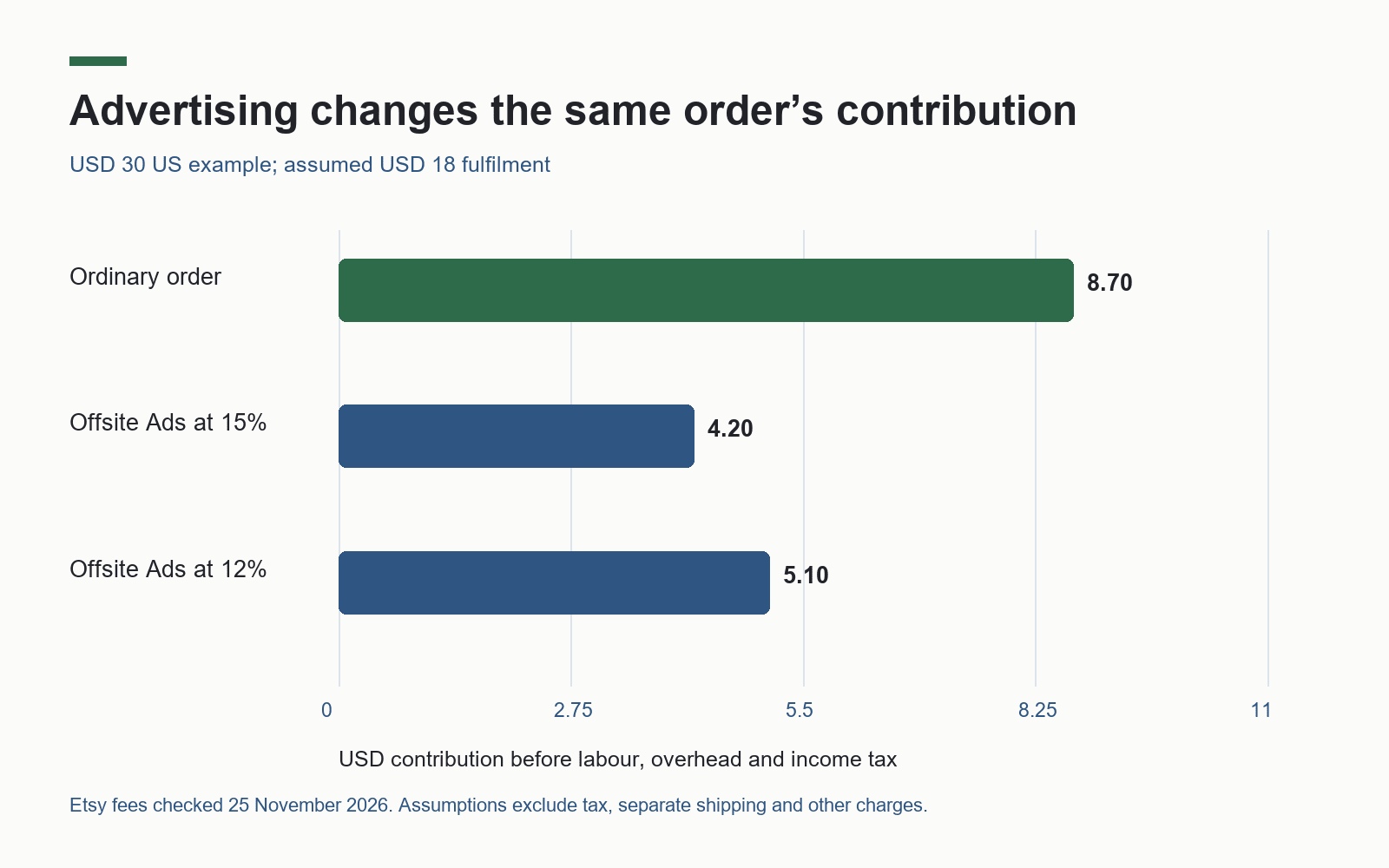
Example, not actual results: A USD 30 order has a USD 1.95 transaction fee, USD 1.15 processing and USD 0.20 listing cost under the stated US assumptions. After assumed USD 18 fulfilment, ordinary contribution is USD 8.70. An additional 15% Offsite Ads charge is USD 4.50, leaving USD 4.20; at 12%, the USD 3.60 advertising deduction leaves USD 5.10. All three amounts are before labour, returns, overhead and income tax.
| Scenario | Example contribution before labour and overhead | What changes |
|---|---|---|
| Ordinary order | USD 8.70 | No Offsite Ads deduction in this model |
| Higher-rate attributed order | USD 4.20 | Advertising is additional |
| Lower-rate attributed order | USD 5.10 | Lower advertising rate is still a cost |
These are contribution figures, not cash you can safely spend personally. They still need to fund support, creation work, subscriptions, replacements and the rest of the business.
How do you calculate a break-even price?
Divide the fixed costs and desired contribution by the fraction of revenue left after percentage deductions. Keep the inputs visible so you can update the model when a quote changes.
Required price = (fulfilment + fixed fees + target contribution) ÷ (1 − percentage fees).
Example target: Keep the assumed USD 18 fulfilment and USD 0.45 combined fixed listing/processing cost, and target USD 6 contribution. At the higher advertising rate, combined percentage deductions are 24.5%, so (18 + 0.45 + 6) ÷ 0.755 = about USD 32.38. Round up to at least USD 32.39 in this simplified model. That price target does not establish buyer demand or include omitted business costs.
Use the Etsy fee calculator and POD profit calculator with the actual order details. A spreadsheet can help when you need to record several product variants, but the assumptions still matter more than the tool.
What should you do before setting a permanent price?
- Quote the actual product route. Include production, print options, shipping and the destination you plan to serve.
- Record the applicable account fees. Use your seller country, payment route and current program status.
- Model ordinary and attributed orders. Keep each scenario separate so an average does not hide an unprofitable order type.
- Add time and a problem reserve. Include personalisation checks, customer messages and likely remedial work.
- Choose a price and a limit. Decide which variants or destinations you can support at that price and what evidence would justify changing it.
Should you opt out if you are eligible?
Evaluate actual attributed orders and contribution before deciding. Additional orders can be worthwhile when they leave enough for the work and risk. More revenue is a poor result if it increases losses or consumes capacity needed for better orders.
Our default recommendation is to make the product viable under the fee route you can receive. If you are eligible to opt out and the economics remain unacceptable, compare that choice with raising the price, improving the offer or reducing fulfilment costs. Avoid assuming an eligibility condition will remain unchanged forever.
Read the digital downloads versus POD comparison if manufacturing costs dominate the problem. Use part two of the design guide to rebuild the package and price, and test one product from the personalized gift shortlist rather than expanding a fragile catalog.
Tip: Save a dated cost sheet with the supplier quote and platform assumptions. When a fee or shipping rate changes, you can update one input and see which products need attention.
Frequently asked questions
Do Offsite Ads replace Etsy’s transaction fee?
No. Model them alongside the ordinary fees that apply to the order.
Does every order get an Offsite Ads fee?
No. Attribution rules determine which orders are charged. Review the order details and Etsy’s current explanation rather than assuming all sales have the same deduction.
Can I use the US example for a Moroccan bank account?
No. Use the processing rate, currency, deposit conditions and other costs for the actual seller account. The US scenario is only a worked method.
Is contribution the same as profit?
No. Contribution after variable order costs still needs to cover labour, fixed overhead and other business obligations.
Sources
- Etsy: How Offsite Ads Work, checked 25 November 2026.
- Etsy: Payment Processing Fees, checked 25 November 2026.
- Etsy: Fees and Payments Policy, checked 25 November 2026.
Information only, not financial, tax or legal advice. Fees and prices change, so check the platform before you act. Disclaimer (opens in a new tab)
Was this article helpful?



Comments