




On this page
Gumroad vs Payhip favours Payhip for a small direct store focused on keeping checkout costs low, provided its payment and tax arrangements fit your business. Choose Gumroad when its merchant-of-record role and existing workflow justify the deduction. We checked the official pages on November 25, 2026. Compare the complete payment route, not just the headline platform percentage.
Gumroad vs Payhip at a glance
Payhip is our default for the low-cost direct-store use case. Gumroad’s tax administration can be valuable, but it should be weighed against your actual obligations and transaction costs.
| Decision | Payhip | Gumroad |
|---|---|---|
| Best fit | A direct storefront with controlled costs | A creator valuing its merchant-of-record arrangement |
| Platform pricing | Free or paid plans with different transaction deductions | Direct-sale and Discover fee routes |
| Processing | Additional provider charges | Check detailed direct-sale fee guidance |
| Tax question | Check what is handled and what remains yours | Merchant of record for applicable transaction taxes |
| Traffic plan | Bring a relevant audience | Do not assume Discover will supply buyers |
What are the current direct-sale fees?
Gumroad’s detailed fee help lists a direct-sale platform fee of 10% plus USD 0.50, with card processing of 2.9% plus USD 0.30 outside that amount. Its Discover marketplace route is a flat 30% including processing. These figures were checked November 25, 2026; account-specific arrangements and payment routes can differ.
Payhip’s plan guidance lists Free Forever with a 5% transaction fee, Plus at USD 29 monthly with 2%, and Pro at USD 99 monthly with no platform transaction fee. Payment processing is additional. Check the full current terms for the provider connected to your account.
Gumroad’s headline pricing page is shorter than its detailed fee explanation. For planning, we use the detailed help page and show processing separately. Confirm the deductions on your own transaction record before setting a permanent price. A payment receipt is more relevant to your business than a simplified marketing headline.
What would a direct sale leave?
The following comparison isolates transaction deductions. It excludes product creation, support, advertising, subscriptions, tax, refunds, currency conversion and payout charges.
Example, not creator results: A USD 20 direct sale under Gumroad’s stated help-page card assumptions has USD 2.50 platform fees plus USD 0.88 processing, leaving USD 16.62. On Payhip Free, a USD 1 platform fee plus an assumed USD 0.88 processor charge leaves USD 18.12. A USD 20 Gumroad Discover sale at the stated all-in marketplace rate leaves USD 14. Use the actual payment route on your account rather than applying this example to every country.
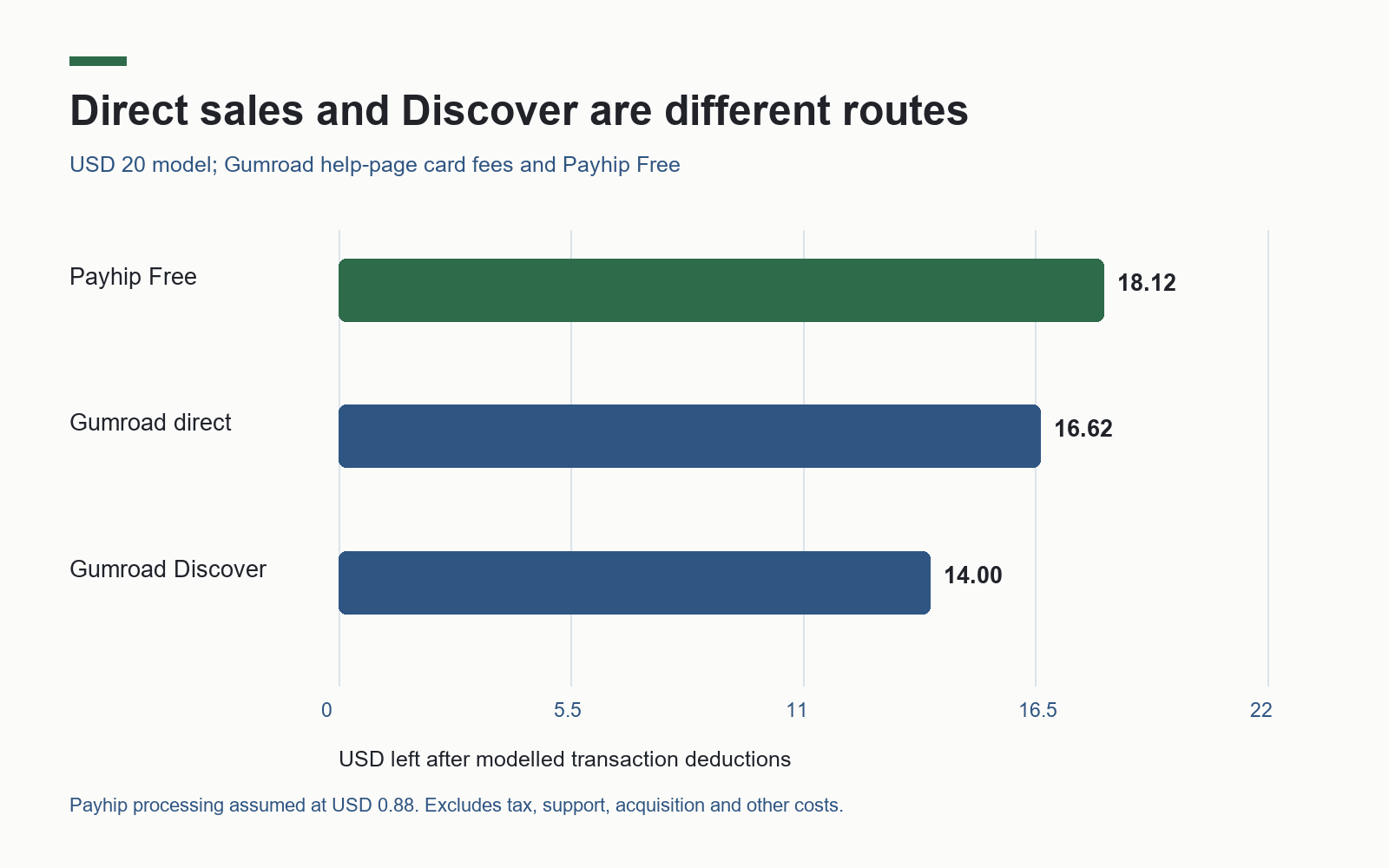
The lower deduction is useful only if the platforms otherwise meet the product’s needs. A file that buyers cannot open, a poorly explained licence or slow support can erase a small checkout saving quickly.
When does a paid Payhip plan break even?
A paid plan starts to save platform fees when the reduction exceeds its subscription cost. Use eligible monthly revenue, not your hoped-for sales total.
Example calculation: Moving from Payhip Free to Plus saves three percentage points in platform fees. USD 29 ÷ 0.03 = about USD 966.67 in monthly revenue for the subscription and saving to balance. Moving from Plus to Pro saves two percentage points and adds USD 70 monthly: USD 70 ÷ 0.02 = USD 3,500. These calculations use the plan prices checked November 25, 2026, assume unchanged eligible revenue and processing, and exclude subscription taxes or discounts.
Do not upgrade because a single unusually strong week makes an annual plan look attractive. Compare several plausible months, including a quiet one, and include the commitment you would actually buy. A subscription that is economical in a busy period may be unnecessary at launch.
What does merchant of record change?
It changes who is selling the transaction to the customer for the relevant payment and indirect-tax arrangement. Gumroad describes itself as merchant of record and says it handles sales-tax collection and remittance where it has obligations.
That does not remove your business’s income-tax, bookkeeping or registration responsibilities. Nor does it automatically resolve every issue with product licences, consumer rights or professional services. Treat these as general distinctions and ask an appropriately qualified adviser about your location and product.
For Payhip, check the current tax features and payment arrangement rather than assuming it is the same contract as Gumroad. The practical question is which responsibilities remain with you and what it would cost to manage them properly.
How should you evaluate features before migrating?
Test the few functions your product actually needs. A download seller should check checkout, file delivery, customer receipts, updates and support. A membership seller needs an additional evaluation of recurring access and cancellation. Do not choose a platform because a feature exists if you cannot verify how it works for your offer.
Prepare a migration inventory before moving a catalog: product versions, customer entitlements, licence wording, active links and support instructions. Keep a record of what each existing buyer purchased. A cheaper platform is a poor move if customers lose access or receive the wrong version.
Which one should you choose?
- Choose Payhip if you bring your own audience, want a straightforward direct store and can meet the obligations left with your business.
- Choose Gumroad if its merchant-of-record setup and your established creator workflow are worth the extra deduction under your payment route.
- Keep the current platform temporarily if migration effort would exceed the realistic saving. Fix the offer and delivery before moving it.
Compare Etsy and Payhip if marketplace discovery is part of the decision. Use part two of pricing and packaging a design to create the offer, then follow part three’s delivery checks before sending traffic.
Frequently asked questions
Does Gumroad’s headline fee include every cost?
Its detailed fee page lists card processing outside the direct-sale platform fee. Check that page and your account’s actual payment route when modelling a sale.
Is Gumroad Discover the same as a direct sale?
No. Discover uses a separate marketplace fee route. Do not compare one platform’s direct traffic with another platform’s customer-acquisition channel as if the services were identical.
Does merchant of record handle my income tax?
No. Transaction-tax administration and the tax on your business income are different obligations. Obtain advice for your jurisdiction.
Should I pay for Payhip Pro immediately?
Start with the lowest-cost plan that fits the actual revenue and requirements. Compare all relevant plans before committing to a subscription.
Sources
- Payhip: Billing and Upgrading, checked 25 November 2026.
- Gumroad: Fee details, checked 25 November 2026.
- Gumroad: Pricing, checked 25 November 2026.
Information only, not financial, tax or legal advice. Fees and prices change, so check the platform before you act. Disclaimer (opens in a new tab)
Was this article helpful?



Comments