




On this page
Digital products to sell should solve a problem you understand, rather than repeat an earnings claim from another seller. Our first choice is a narrow editable business asset when you know the customer’s workflow; for an illustrator, original print-ready artwork may be the better fit. We checked the platform and licensing sources on November 25, 2026. Start with one useful result and price its support burden.
Which digital products to sell fit your existing skill?
Choose the format you can create, explain and maintain competently. A fashionable format is a poor fit when you cannot judge whether its output works.
| Product | Best skill match | Buyer’s result | Hidden work |
|---|---|---|---|
| Editable business layout | Practical design and client knowledge | Finish a recurring document | Compatibility and editing help |
| Print-ready original art | Illustration and print preparation | Print a chosen artwork | Size and print questions |
| Original asset pack | Consistent visual production | Reuse a coherent set of elements | Licence clarity and file organisation |
| Focused spreadsheet | Accurate workflow and formula design | Complete a specific calculation or log | Formula checks and updates |
| Event stationery set | Layout and production knowledge | Produce coordinated materials | Fonts, bleed and personalisation |
These are product directions, not a list of proven sellers or expected earnings. We have not verified demand for your particular execution. Use part one of the original-design guide to test the buyer problem before building the whole pack.
1. An editable business layout is our practical first pick
A narrow business layout works when it saves a repeat task for a customer you understand. Examples include a service-menu layout or a simple client handover document. Sell a specific use, not a giant bundle of unrelated pages.
It suits someone with real knowledge of how the buyer works. Include a completed demonstration using clearly fictional content, a clean editable version and concise instructions. State what software is required and which parts the buyer can change.
Price decision: Estimate creation recovery and support per sale before setting a test price. A reusable layout can become a custom service if every buyer expects you to write their content. Offer that work separately, using a clear productized-service scope.
2. Print-ready original artwork suits an illustrator
Original art downloads fit buyers who want the artwork and are comfortable arranging their own printing. The value is the visual work and the usable export, not an implied shipment of a framed object.
Provide the sizes and formats actually included. Show the supplied artwork accurately and explain what happens when a buyer prints at a different aspect ratio. Do not describe every file as universally suitable for every printer or surface.
Price decision: Compare your proposed price with the work and licence supplied, then include support for print questions. If the buyer mainly wants a finished physical gift, digital downloads versus POD may lead to a better format decision.
3. An original asset pack serves a repeat creative task
An asset pack can be useful when the elements form a consistent visual system: your own icons, textures or illustrations for a defined task. A random collection is harder to evaluate and support.
Create an index and use predictable file names. Check dimensions, transparency and consistency across the full set. Explain whether the licence permits commercial end products and what it does not permit, such as redistributing the source pack unchanged.
Price decision: Price the usable set and the permission you can grant. Do not promise exclusivity when the same assets are sold to multiple buyers or include third-party material. Canva’s sales guidance specifically distinguishes original products from standalone resale of library content; an asset pack requires particular care about what you created yourself.
4. A focused spreadsheet is a product with maintenance
A spreadsheet works when it helps someone complete a narrow, understandable task. A project-cost log or stock-count sheet can be easier to validate than a complex financial model with broad claims.
Test blank inputs, normal inputs and errors. Separate editable cells from calculations, explain units and currencies, and verify that totals update correctly. Include a small fictional example that demonstrates the workflow without pretending to report business results.
Price decision: Include testing, software compatibility and future maintenance. Do not sell a tool as tax, legal or investment advice if it cannot support that claim. If the buyer needs substantial configuration, a fixed-scope setup service may be more honest than an “instant” product.
5. A coordinated stationery set serves one event
A stationery set can solve a clear visual job when its pieces share sizes, styles and production assumptions. Choose a defined event or business use rather than promising a template for every occasion.
Explain fonts, editing requirements, bleed and what the printer must receive. Test a real output before making print-quality claims. Personalisation needs a boundary: changing supplied text is different from rewriting or redesigning the whole set.
Price decision: Count the support created by deadlines and printer questions. Keep a versioned package and check all pages after a revision. For templates made with licensed content, confirm the permitted delivery format before offering the files.
How do platform fees affect a small product?
Fixed transaction charges matter more when a selling price is small. Bundling can help only if the bundle is useful and buyers actually want its contents.
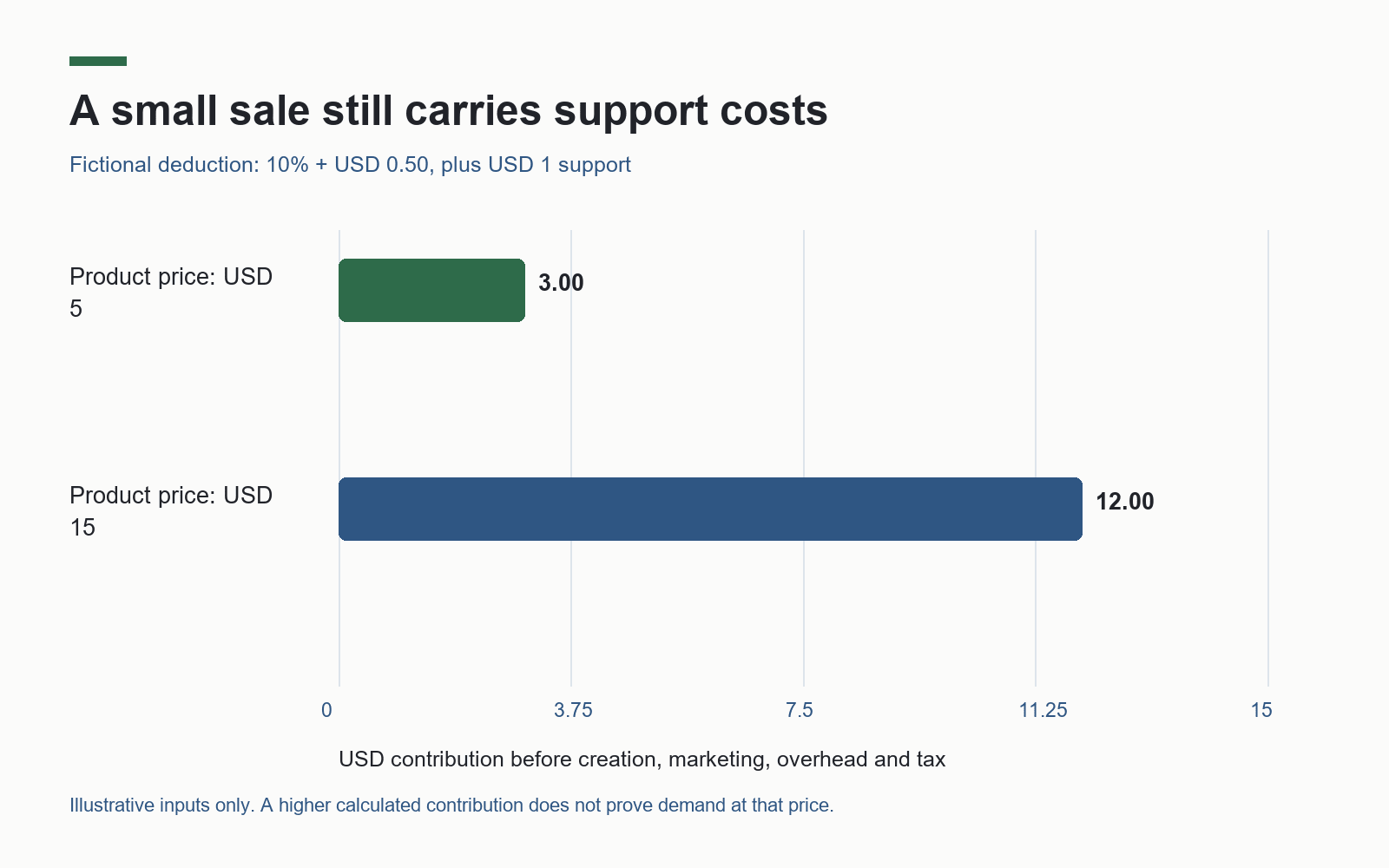
Example, not a platform rate: Assume selling and payment costs total 10% plus USD 0.50, and allow USD 1 for support. A USD 5 item leaves USD 3 before creation, marketing, overhead and tax. A USD 15 item leaves USD 12 under those same assumptions. That does not prove a higher price will sell; it shows why price, usefulness and support must be designed together.
Etsy explains its digital listing workflow, while Payhip describes direct download delivery. Neither description proves that the platform will find buyers for your product. Compare Etsy with Payhip and Gumroad with Payhip using your actual route.
Which product should you reject?
Reject an offer that depends on copied work, unclear licences, fake expertise or a result you cannot verify. Also reject a bundle whose only selling point is a large file count.
A useful first product has a small promise: who it helps, what it lets them finish and what it excludes. Build and test that promise, then use part two’s packaging checklist before launch.
Sources
- Etsy: How to Manage Your Digital Listings, checked 25 November 2026.
- Payhip: Digital Downloads, checked 25 November 2026.
- Canva: Using Designs in Products for Sale, checked 25 November 2026.
Information only, not financial, tax or legal advice. Fees and prices change, so check the platform before you act. Disclaimer (opens in a new tab)
Was this article helpful?



Comments