



On this page
Redbubble vs TeePublic is a comparison of artist earnings after the rules attached to your actual account. Checked November 28, 2026, our default is TeePublic for a simple catalog when its assigned category payout works for the artist. Choose Redbubble when markup control adds value after its applicable account fees. Neither marketplace supplies evidence that a design will sell.
How does Redbubble vs TeePublic compare?
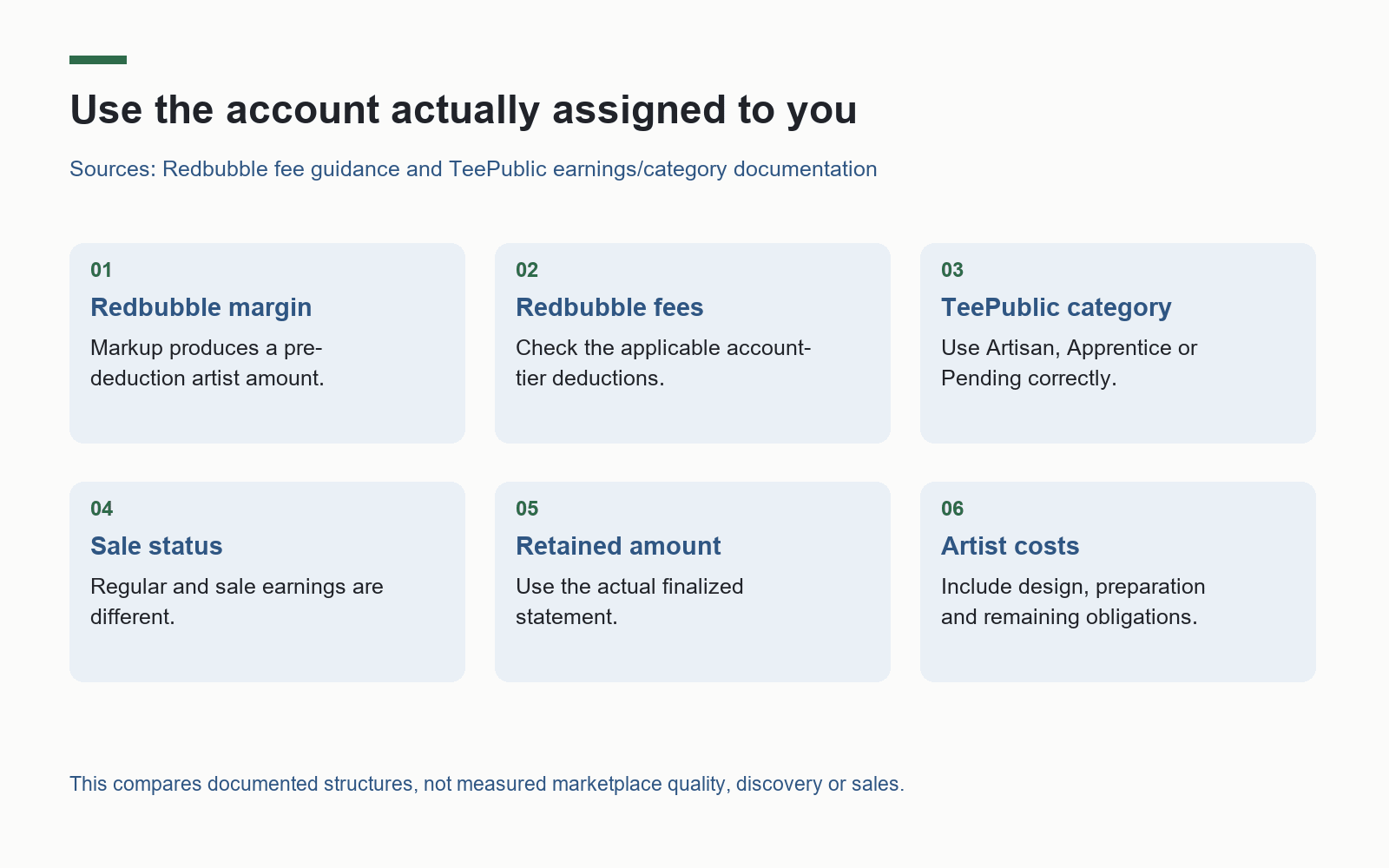
Redbubble uses an artist-markup model with account-tier deductions that can apply. TeePublic publishes product earnings by account category and regular or sale status. The amount displayed beside a product is not necessarily the artist’s final spendable profit.
| Decision | Redbubble | TeePublic |
|---|---|---|
| Our default use case | Artist who values markup control and has checked deductions | Simple catalog with an acceptable assigned-category payout |
| Earnings structure | Artist margin from markup, with applicable fees | Published product earnings by category and sale status |
| Important account distinction | Standard, Premium or Pro | Artisan, Apprentice or Pending |
| Main calculation trap | Calling pre-fee margin the payout | Assuming every artist gets the Artisan regular amount |
| Evidence still needed | Actual category, product outcome and final statement | The same, with the correct sale status |
We checked the public documentation and earnings pages. We have not opened stores, ordered samples or measured comparative discovery, quality or sales.
How does Redbubble calculate an artist margin?
Redbubble’s payment explanation distinguishes base price, markup and the cash artist margin. The margin is calculated from the relevant base price, so discounts, destination and other product conditions can change the outcome.
Its account-fee page describes platform and excess-markup fees for Standard and Premium accounts, with Pro exempt. The excess-markup condition concerns markup above 20%. Read the full current calculation for your tier rather than assuming every artist is exempt or every fee is a fixed amount.
A configurable markup is useful only if the resulting customer price remains appropriate and the after-fee result justifies the work. Raising the markup does not establish that demand stays unchanged.
How does TeePublic calculate artist earnings?
TeePublic’s category explanation says Artisan and Apprentice accounts receive different earnings, with Pending using Apprentice earnings. Check the actual assigned category before modelling a catalog.
For an Artisan classic T-shirt, TeePublic’s published chart lists USD 4 at regular status and USD 2 on sale. That is a specific chart entry, not the rate for every product, artist category or period. Do not apply the regular amount to a sale transaction.
The chart-based structure can make a first cost model easier, which is why it is our default in the stated use case. It does not establish better discoverability, production quality or total earnings.
How do you compare what remains after your work?
Use the actual artist amount after applicable marketplace deductions, then subtract your own creation and operating costs. Compare the same product type, assigned account status and period.
Hypothetical work recovery: assume an artist has USD 40 of design and preparation cost to recover. At an assumed USD 2 retained contribution per sale, twenty sales cover that cost; at USD 1, forty are needed. These are invented after-deduction inputs for the equation, not a Redbubble quote, a TeePublic forecast or evidence that either volume will sell.
Record the complete time spent preparing files, adjusting placements, writing listings and answering questions. A design uploaded to several products still needs a placement check on each product.
What should you inspect before listing?
Inspect the artwork at the actual print dimensions and check how it wraps or crops. A design that works on a shirt may not suit a small sticker or a narrow object. Fewer carefully checked products can make a more coherent first catalog.
Use original artwork and documented permissions. Marketplace availability of similar designs does not establish that copying a brand, character or protected work is permitted. If using a formal fan-art program, follow its actual scope rather than assuming it clears all related products or destinations.
Keep realistic product claims. A digital mockup cannot prove material quality, wash performance or the packaging that arrived. Obtain real evidence before making those claims.
When might another route fit better?
Choose another route when the audience needs a product or control the marketplace does not provide. An original book has different production and economics; our KDP paperback guide is a separate path, not a substitute shirt platform.
For audience building, a useful blog or newsletter can show the original process and help people understand the work. Pinterest discovery also has its own commercial rules; traffic is not automatically a sale.
If AI contributes to a different publishing product such as a book, check the specific KDP disclosure rules rather than transferring a policy between marketplaces.
Which one should you choose?
Choose TeePublic if you want the simpler published-earnings model and the amount for your actual category and sale mix is acceptable. Do not assume Artisan status before it is assigned.
Choose Redbubble if markup flexibility suits the offer and you have calculated the relevant account deductions. Judge the final result, not the largest possible pre-fee margin.
Our recommendation: test a small original catalog on one marketplace, learn from real statements and product evidence, then consider another channel. Avoid building a large catalog around an unverified earnings assumption.
Frequently asked questions
Does TeePublic pay every artist the same amount?
No. Its documentation distinguishes account categories, products and regular or sale status.
Is Redbubble artist margin the final payout?
Not necessarily. Applicable account fees and other conditions must be considered before treating it as retained income.
Can I assume my account will be Artisan or Pro?
No. Use the classification actually assigned and the terms applying to it.
Which platform guarantees more sales?
Neither guarantee is established here. This comparison covers documented earnings structures, not measured sales performance.
Sources
- payment explanation, checked November 28, 2026.
- account-fee page, checked November 28, 2026.
- category explanation, checked November 28, 2026.
- TeePublic’s published chart, checked November 28, 2026.
Information only, not financial, tax or legal advice. Fees and prices change, so check the platform before you act. Disclaimer (opens in a new tab)
Was this article helpful?


Comments