




On this page
KDP AI content rules require disclosure of generated text, images and translations. Checked November 28, 2026, our recommendation is to record how each component was created and review the complete book before uploading. Treat the creation record as a practical production tool: it should help an editor locate the current files, understand their origins and identify work still needed.
What do KDP AI content rules require?
KDP’s content guidelines cover new books and edited republications. Actual AI-created content remains generated after substantial editing; help refining your own content is distinguished as assistance. Publishers remain responsible for rights and customer experience.
In our recommended production record, keep the creative process visible beside the final asset. An editor should be able to identify which file is in the book and find the evidence relevant to that file without reconstructing a month of unrelated drafts.
This guide summarizes the documented distinction and provides an editorial review process. It is not a legal finding about ownership of a particular output.
What should you record before uploading?
Record the manuscript, cover, interior illustrations and translations separately. A human-written book can still contain generated cover artwork, and an original cover does not establish how the manuscript was made.
Use the tools you already have: a folder of drafts, an asset register and a version note are enough to start. Budget time for factual checking, editing, layout review and any real proof order. Do not treat a fast generation time as the complete production cost.
Keep the version that was actually published. If you later replace a cover or translate a chapter, update the record rather than relying on the first edition’s description.
How do you review the book step by step?
Review origin, permissions and reader quality as separate questions. A positive answer in one column does not settle the others.
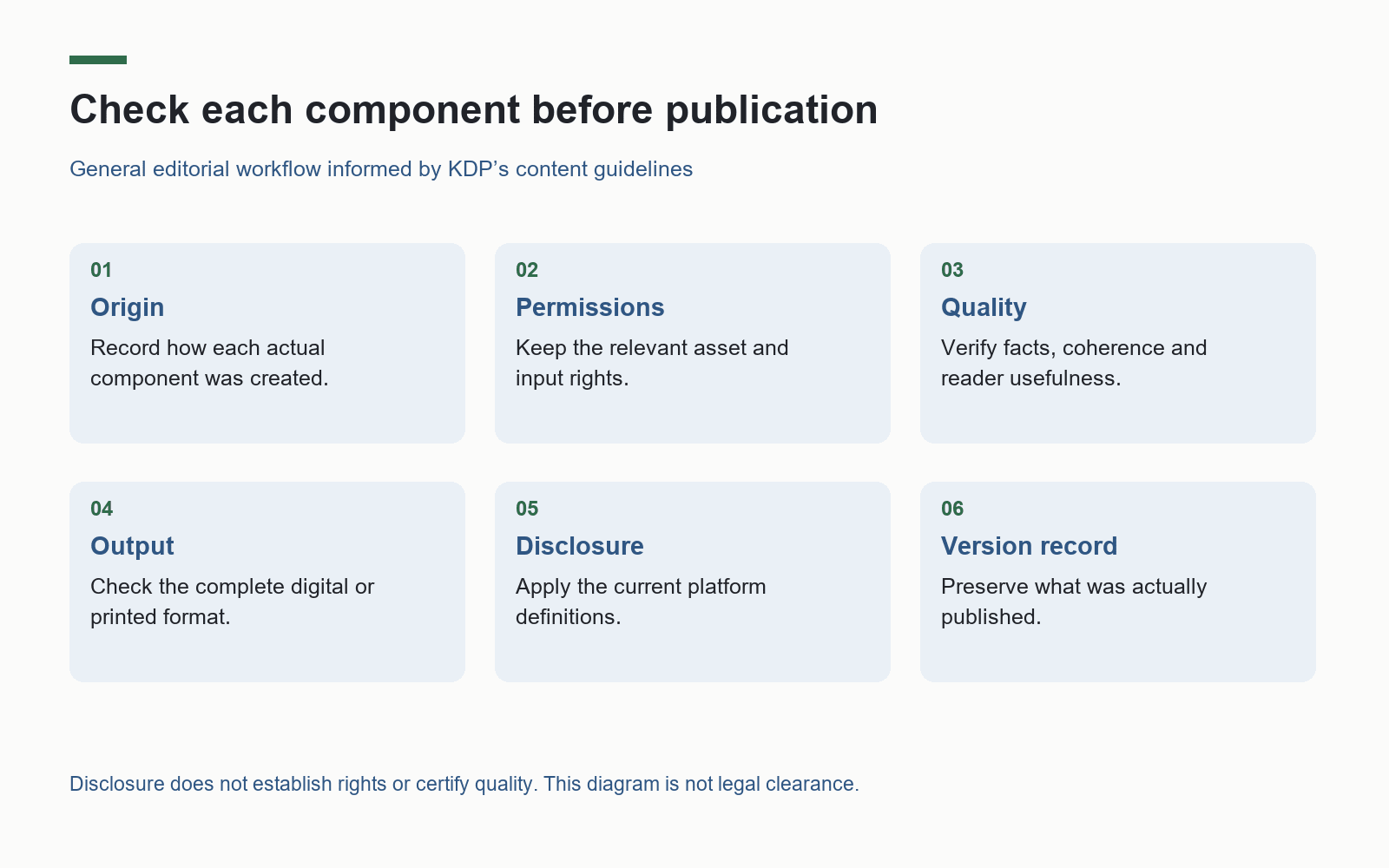
- Inventory every content component. Include the manuscript, cover, interior art, diagrams, photographs and each translation. Identify who or what created the actual material.
- Classify the workflow accurately. Apply KDP’s current definitions to the actual content creation, not the amount of editing or your preferred label.
- Keep input and asset permissions. Record licences for stock material, uploaded references, fonts and other included assets. A tool’s commercial-use statement does not resolve every third-party element.
- Check the substance. Verify factual claims, calculations, citations, names and examples. Read the complete book for repetition, contradictions and gaps that would frustrate a customer.
- Check the actual output format. Review navigation, image placement, typography and readability. Use appropriate previews and a real print proof for the physical edition.
- Disclose and preserve the publication record. Answer the platform’s questions truthfully, keep the final files and document later changes when updating the book.
Tip: Add columns for origin, rights evidence, quality reviewer and published version. Avoid using a single checkbox called “AI cleared” for several different questions.
What if you rewrite generated text heavily?
Keep the original draft, intermediate revisions and final manuscript together. Record the actual sequence of work while it is still easy to verify, then use the definition above when completing the platform’s form. A percentage-of-words guess is a poor substitute for a clear creation history.
For example, your register could identify a chapter file, its creation method, the editor who checked it and the final version date. Give a replacement illustration its own entry. This is our suggested organization method, not a required KDP template. It helps the person reviewing an update see what changed and locate the relevant permissions and quality checks.
Does disclosure make the book safe to sell?
No. Disclosure is one platform requirement, while rights, accuracy and reader value remain separate. A generated image can resemble protected material, a translation can be wrong and a fluent paragraph can contain a false claim.
For uncertain rights or sensitive subject matter, get qualified advice or choose another approach. Local law, contracts and marketplace rules can answer different questions. This article provides general information, not individual legal advice.
For an original work, keep evidence of the underlying creative process and permissions. Do not claim that a book is human-illustrated or hand-painted when that is not how its actual artwork was created.
How do these checks affect the budget?
They add real production work that belongs in the cost model. A cheap initial generation can still require extensive verification, editing and replacement of unsuitable material.
Hypothetical production record: assume two hours creating a draft, seven hours fact checking and editing, three hours formatting and two hours checking previews. The complete workflow takes fourteen hours before marketing or support. These invented times illustrate why generation time alone is a weak cost measure.
Use KDP paperback royalties to compare those costs with the appropriate unit economics. The royalty calculation cannot tell you whether the manuscript deserves publication.
What should you do before choosing a format?
Choose the format that serves the reader and can be checked properly. Our Kindle ebook versus paperback comparison covers the additional preparation each needs.
If adapting your own existing articles, follow a controlled repurposing workflow and keep source dates and rights consistent. A collection of old posts still needs coherent editing to become a useful book.
Our recommendation: keep an honest creation record, disclose generated components and publish only a complete work that meets the reader’s task. Do not use disclosure as a substitute for reviewing the book.
Frequently asked questions
Do AI-generated covers need disclosure to KDP?
Yes. Review cover and interior images separately from the manuscript.
Does heavy editing remove the generated classification?
No. Apply the platform’s definition and retain the original creation record.
What should a small asset register contain?
Our suggested starting columns are the file name, origin, permissions, reviewer and published version. Expand them when the project needs more detail.
Does disclosure prove copyright or quality?
No. Permissions, applicable law, accuracy and customer experience require separate review.
Sources
- content guidelines, checked November 28, 2026.
Information only, not financial, tax or legal advice. Fees and prices change, so check the platform before you act. Disclaimer (opens in a new tab)
Was this article helpful?



Comments