




On this page
Productized services turn a repeatable freelance result into a clear package with defined inputs, deliverables and limits. Start with work you can already perform well, then test a small paid pilot before promising speed or scale. We checked the platform sources on November 25, 2026. The aim is a sustainable client offer, not an earnings promise or unlimited work hidden behind a fixed price.
When do productized services make sense?
A service is ready to package when the result, process and usual sources of variation are understood. A presentation-formatting package can be bounded; “do anything needed to improve our marketing” cannot.
This approach suits a freelancer who has enough practice to estimate the job and judge its quality. It is a poor fit when each project requires a new diagnosis, specialist advice or extensive custom research that the advertised package does not include.
- Time: Allow an offer-design session and a complete practice delivery before setting turnaround promises.
- Cost: Count software, licences, payment or platform deductions, acquisition and the full delivery workload.
- Tools: A relevant sample, an intake checklist, a scope document and a way to record time.
- Output: One package a buyer can understand and a freelancer can deliver consistently.
| Part of the offer | Write down | Why it matters |
|---|---|---|
| Result | What the client receives | Makes success checkable |
| Inputs | What the client must supply | Prevents an impossible start |
| Boundary | Excluded work and revision scope | Controls hidden obligations |
| Acceptance | How completion is judged | Reduces ambiguous disputes |
| Price | Whole-job costs and contribution | Protects the return on time |
How do you build the first package?
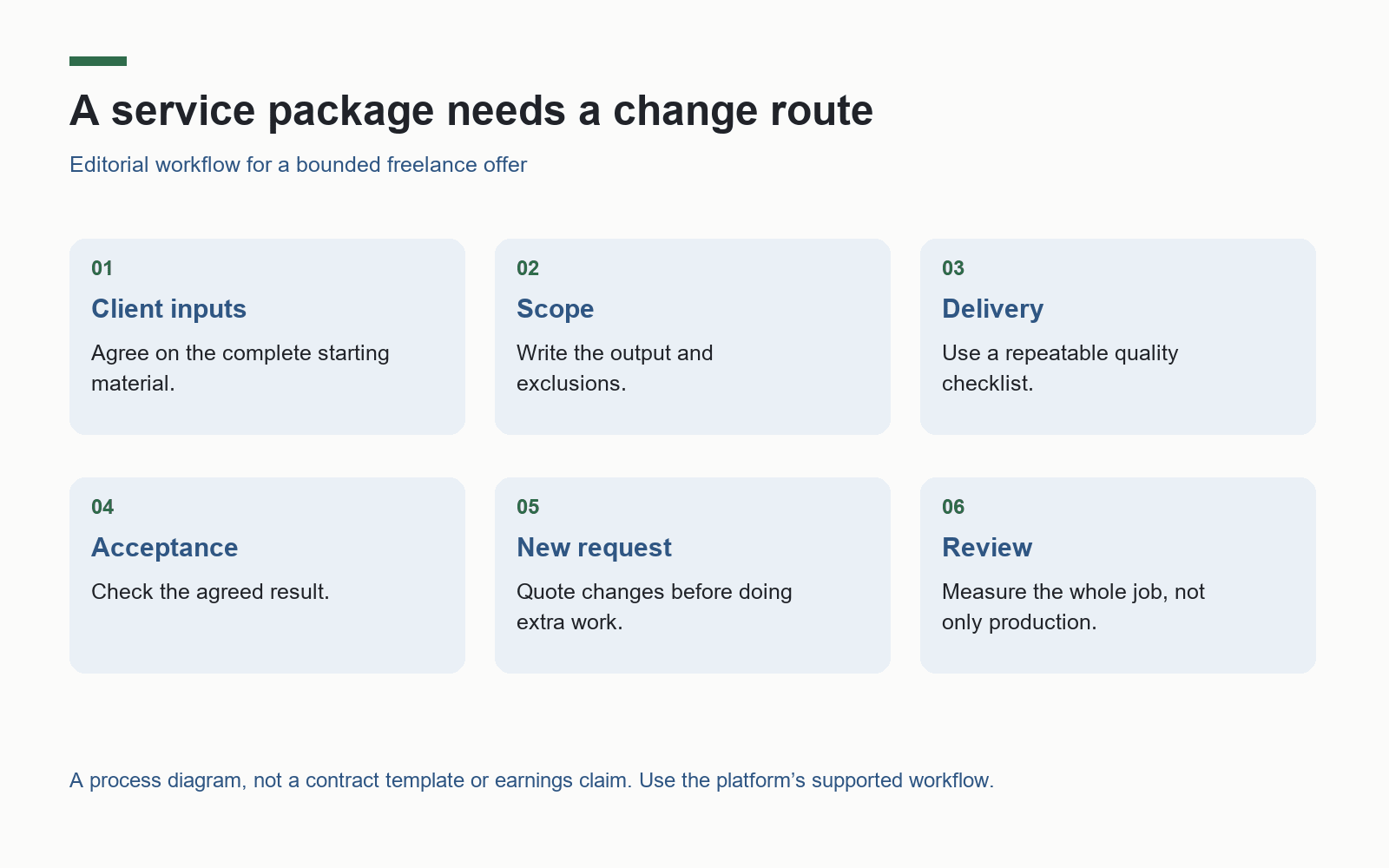
Build the package around a completed client result, then remove ambiguity about what is required to produce it. The following steps work for practical services such as formatting, editing within your competence or preparing approved content for a defined channel.
- Choose one repeatable outcome. Name the final file, handover or completed task. Avoid promising a business result you cannot control, such as sales or search rankings.
- Define the starting inputs. List the approved copy, source files, brand assets or access needed. State that the schedule begins when the required inputs are complete, using terms appropriate to the platform and contract.
- Set boundaries and change handling. Explain what the package excludes, how corrections differ from new requests and when an additional quote is needed. A revision should not become an unrelated project.
- Specify acceptance checks. Define file formats, the delivery checklist and the way the client confirms completion. Make the checks understandable without specialised vocabulary.
- Run a measured pilot. Deliver a practice or honestly agreed paid pilot, record the whole workload and revise the package before advertising a faster turnaround.
What does a clear package description look like?
A clear description includes the output, inputs and exclusions. Consider a fictional presentation-formatting offer: the client supplies approved text, a brand guide and an existing slide deck; the freelancer applies an agreed layout style, checks alignment and exports the specified files.
The description should say whether it includes copywriting, chart redesign, image licensing or extra versions. If those are excluded, the price must not imply that they are quietly included. A buyer who needs them can request a separate scope before ordering.
Do not use a sample made from confidential client work without permission. A self-created demonstration can show the skill honestly when it is identified as a demonstration rather than a paid customer result.
How should you price the whole job?
Price acquisition, delivery, revisions and administration together. Your target working rate is a planning choice, not evidence that clients will pay it.
Example, not expected earnings: Suppose a package requires six production hours, one acquisition hour and one administration/revision hour. At a chosen planning value of USD 20 for each of those eight hours, plus USD 10 direct costs, the amount needed after a platform deduction is USD 170. If the assumed deduction is 20%, the price floor is 170 ÷ 0.80 = USD 212.50 before tax and other overhead. A USD 220 price would leave USD 166 after that deduction and direct cost, or USD 20.75 per total hour. These are fictional inputs, not a market-rate claim.
Fiverr’s earnings page states its freelancer share; Upwork’s fee guidance explains contract-specific deductions. Substitute the actual route when pricing, as shown in Upwork versus Fiverr.
If the affordable client price falls below your floor, reduce unnecessary work, change the scope or find a different fit. Do not solve the mismatch by promising unlimited revisions and hoping the buyer will not use them.
How do you prevent late inputs and revision loops?
Make the intake checklist part of the agreement. A delivery promise is difficult to meet when a client has not supplied the files required to start.
Ask for a single decision-maker or a consolidated feedback route when possible. Several contradictory reviewers can create work that no fixed package anticipated. Record the agreed brief, then separate corrections to that brief from a change in direction.
Use the platform’s supported process for changes and disputes. Fiverr’s order-process guidance is one example of why a marketplace workflow should be understood before promising a separate off-platform arrangement.
Where does AI assistance fit?
AI can assist with low-risk drafting or organisation when the client agreement, confidentiality duties and tool terms permit it. You remain responsible for the deliverable and should review the output before using it.
Do not upload private client material to a tool without the necessary authorisation. Do not present generated research, citations or graphics as verified work without checking them. If the client pays for a particular human skill or prohibits AI, honour that requirement.
Our recommendation is to use automation only after you understand the manual workflow. Otherwise you may repeat the same error faster across several clients.
When should you turn a service into a product?
Consider a reusable product when the same buyer problem can be solved without repeated custom intervention. A layout, worksheet or original asset set might emerge from a process you understand, provided you own the rights and do not disclose client material.
Compare useful digital product directions, then validate the buyer need. Keep a custom service for cases where the client still needs diagnosis, judgment or substantial adaptation. A downloadable file should not promise the personal support of a commission unless it is priced and staffed accordingly.
Tip: After each pilot, record the task that took longer than expected and why. Improve the scope or process before changing the advertised turnaround.
Frequently asked questions
Are productized services passive income?
No. They are services with clearer boundaries and a repeatable process. Delivery, quality control and client communication still require work.
Should I include unlimited revisions?
We recommend a defined revision scope and a clear route for new work. Unlimited revisions make time and price difficult to control.
Can beginners sell a fixed package?
Yes, when they can reliably deliver the promised result and describe its limits. Do not use a package to hide a lack of the required skill.
What if a client requests extra work?
Clarify whether it corrects the agreed deliverable or changes the scope. Use the platform or contract’s supported change process before starting additional work.
Sources
- Fiverr: Freelancer Order Process, checked 25 November 2026.
- Fiverr: Your Earnings Page, checked 25 November 2026.
- Upwork: Freelancer Service Fee, checked 25 November 2026.
Information only, not financial, tax or legal advice. Fees and prices change, so check the platform before you act. Disclaimer (opens in a new tab)
Was this article helpful?



Comments