



On this page
AI-assisted POD needs several separate checks: the tool’s commercial terms, the rights in inputs and outputs, marketplace rules and the accuracy of the product listing. Our recommendation is to use AI as an assistant and keep a design record, rather than treating a commercial-use checkbox as clearance. We checked the official US and platform sources on November 25, 2026. This is general information, not legal advice for a particular design or country.
What should an AI-assisted POD rights check cover?
It should identify what you created, what you licensed and what could belong to someone else. These questions overlap, but one permission does not automatically answer all of them.
| Check | Question | Record to retain |
|---|---|---|
| Tool terms | Does the account permit the intended commercial use? | Terms and plan version |
| Inputs | Do you have permission for uploaded material? | Source files and licences |
| Output | Does the result resemble protected work or branding? | Review notes and rejected alternatives |
| Human contribution | What expressive work did you create? | Drafts, edits and arrangements |
| Marketplace | Does the listing meet the channel’s rules? | Applicable policy and final listing |
- Time: Review rights before polishing or ordering a sample; revisit the record when the design or tool terms change.
- Cost: Licences, samples and professional advice may be required. There is no universal low-cost clearance package.
- Tools: An asset register, the original files and the official terms for the services you use.
- Output: A traceable design package with unresolved issues removed or appropriately reviewed.
Does a commercial AI licence settle copyright?
No. A tool’s permission to use output commercially is a contractual question; copyright protection and third-party rights are different questions.
The US Copyright Office’s January 29, 2025 report announcement explains that sufficient human-authored expressive elements can qualify for protection, including creative arrangements or modifications, while prompts alone do not establish that authorship. AI assistance does not automatically prevent protection for human contributions. This is US guidance, not a new worldwide rule announced in November 2026.
That distinction matters when selling exclusivity. Do not promise that a buyer receives enforceable exclusive rights in every part of an output unless you can support the promise. Preserve the human-authored work and obtain advice for an important licence or dispute.
How do trademarks create a separate risk?
A design can raise a branding issue even when it is not a copied illustration. A slogan, name or visual identity may suggest a connection with another business.
The USPTO’s likelihood-of-confusion guidance explains that marks can conflict through similarity in sound, appearance or meaning when the goods or services are related. Its search guidance recommends a broader clearance process that includes more than exact matches in one database.
Do not interpret an empty search result as worldwide permission. Existing marketplace listings are also not evidence that a phrase is available. If a product relies on a recognisable brand association, choose another concept or get a competent legal assessment.
How do you build a usable design record?
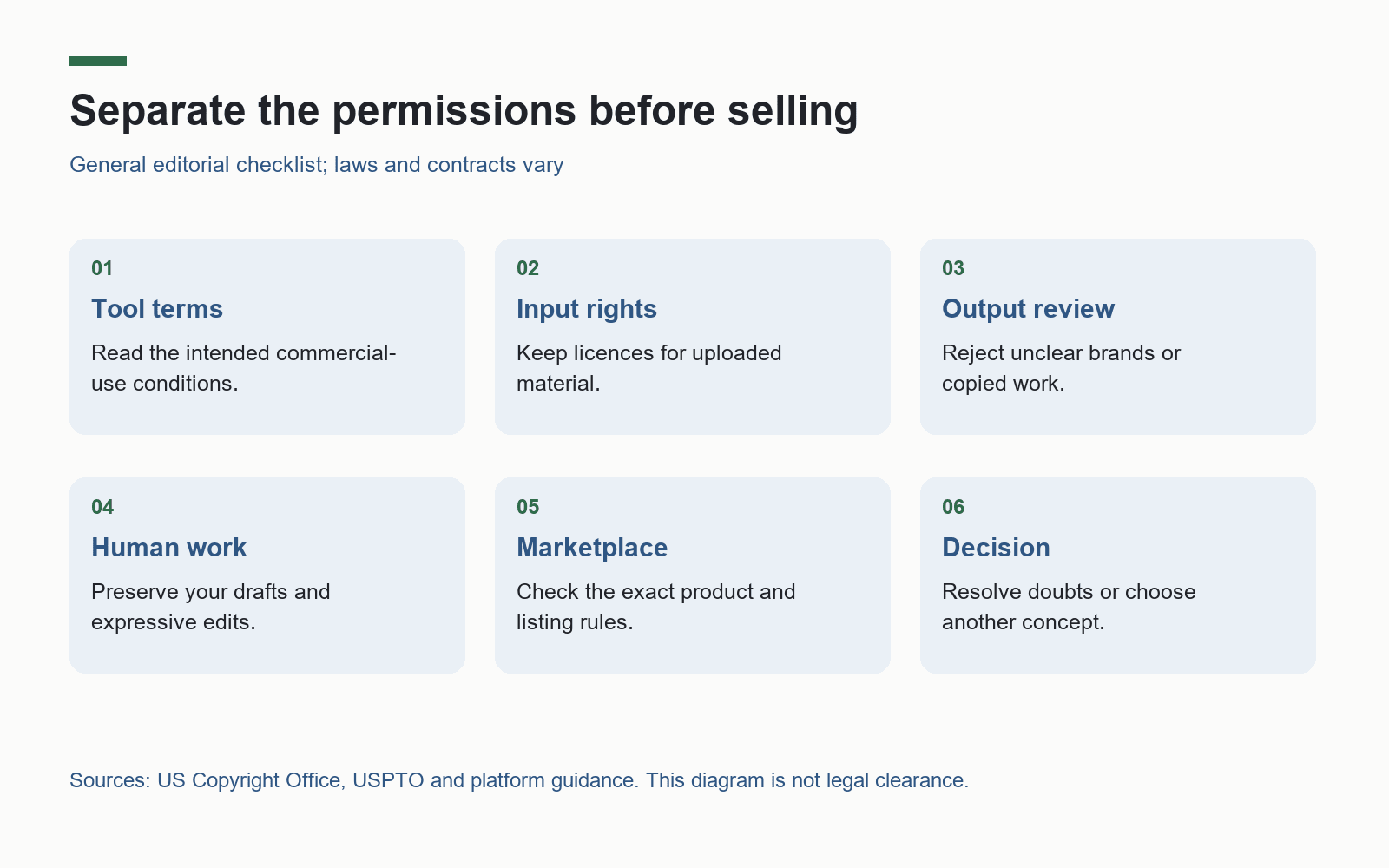
- Record the original concept and inputs. Keep your sketches, licensed assets and any material uploaded to a generation tool. Do not use a client’s or another artist’s private files without permission.
- Save the relevant tool terms. Record the account or plan used and the commercial conditions you relied on. Revisit them when the intended use changes.
- Review the output critically. Look for familiar characters, logos, slogans, distinctive copied compositions and misleading product features. Reject doubtful concepts rather than adding a disclaimer to an unresolved problem.
- Preserve your creative work. Save meaningful drafts, edits and arrangements so you can explain what you contributed. Do not claim that a prompt history alone proves every right you need.
- Check the final selling route. Review the supplier’s requirements, marketplace policy and listing images for the exact product. Keep the final export tied to the version listed and fulfilled.
What if the design uses a library asset?
Read the asset licence for the actual delivery format. A permission to use an element in an end product may not permit redistributing the editable source or selling the element by itself.
Canva’s product guidance distinguishes original designs from standalone resale of its content and describes conditions for templates. A library subscription should not be treated as ownership of every included asset. Keep the terms with the project and avoid promising a customer more rights than you hold.
If the product depends on several assets from different sources, maintain a simple register with the file, source, permission and intended use. If you cannot establish the permission, replace the asset with original work or an appropriately licensed alternative.
Can generated imagery replace a real sample?
No. A generated picture can illustrate an idea, but it cannot establish the actual garment, finish, print quality or delivery result. Use truthful previews and the evidence required for the product type.
For the current platform details, read the separate Etsy AI photo-rule explainer. For the licence that applies to posted seller content, read Etsy’s revised AI terms. Neither article should be used as a substitute for a review of your particular legal position.
Which designs should you decline to sell?
Decline designs that depend on unclear permission, copied branding or a quality claim you cannot verify. Also decline a customer request to add protected characters or logos without the necessary rights, even if they say another seller will do it.
A safer practical alternative is an original concept built around the buyer’s general interest rather than a protected identity. For example, create your own botanical composition instead of imitating a familiar entertainment franchise. This reduces one obvious source of risk without promising that every original-looking work is legally cleared.
Use part one of the original-design guide to develop a buyer-focused concept and part two to package the permissions honestly. Choose a product from the personalized POD shortlist only after the design record is in order.
Tip: Keep rejected concepts in a separate private folder with a short reason. This helps prevent a questionable design from returning to the catalog during a later export or bulk upload.
Frequently asked questions
Does commercial use mean I own all copyright?
No. Contractual permission, copyright protection and third-party rights are separate questions. Read the tool terms and applicable law.
Does changing a famous character make it safe?
Do not assume so. Altering a recognisable protected character or brand can still create rights issues. Choose an original concept or obtain appropriate advice.
Can I guarantee exclusive rights in AI output?
Only promise rights you can establish and grant. For an important exclusivity agreement, get a qualified review of the actual work and contract.
Are these rules the same everywhere?
No. Jurisdictions, tools and marketplaces differ. The US sources cited here should not be treated as a worldwide clearance procedure.
Sources
- US Copyright Office: AI report announcement, January 29, 2025, checked 25 November 2026.
- USPTO: Likelihood of Confusion, checked 25 November 2026.
- USPTO: Why Search for Similar Trademarks?, checked 25 November 2026.
- Canva: Using Designs in Products for Sale, checked 25 November 2026.
Information only, not financial, tax or legal advice. Fees and prices change, so check the platform before you act. Disclaimer (opens in a new tab)
Was this article helpful?
Comments