




On this page
Etsy AI photo rules require a product-type check, not a blanket deletion of every POD mockup. Etsy announced updated AI guidance on October 22, 2026; its listing-image policy, updated November 5, sets out exceptions for POD and digital downloads. We checked both on November 25. Start by replacing images that misrepresent what a customer receives.
What happened
Etsy’s Listing Image Requirements say most products need an unedited photograph of the actual item against a real background. The policy has separate rules for different product types. It permits authorised stock mockups when a production partner prints a seller’s original design on a standard base product. Digital downloads generally need a preview or excerpt of the supplied content.
The October announcement also addresses misleading AI use and says functional guides such as patterns, recipes and instructions must be the seller’s own work, rather than AI-generated information. This is a distinct issue from whether an original piece of AI-assisted artwork may be sold.
Why it matters
An attractive picture can still create an expensive mismatch. A generated mug may have a print area, finish or handle that your supplier does not offer. An edited shirt may look heavier or more fitted than the base garment. When buyers judge the delivered item against those promises, the seller has a support problem even before any policy question arises.
The useful response is an image audit tied to the actual product. Keep the supplier SKU, design export and chosen preview together. Compare the shape, colour, print placement, scale and included accessories. Remove any decorative prop that a buyer could reasonably mistake for part of the purchase, or explain it clearly in the listing.
How should you audit Etsy AI photo rules by product?
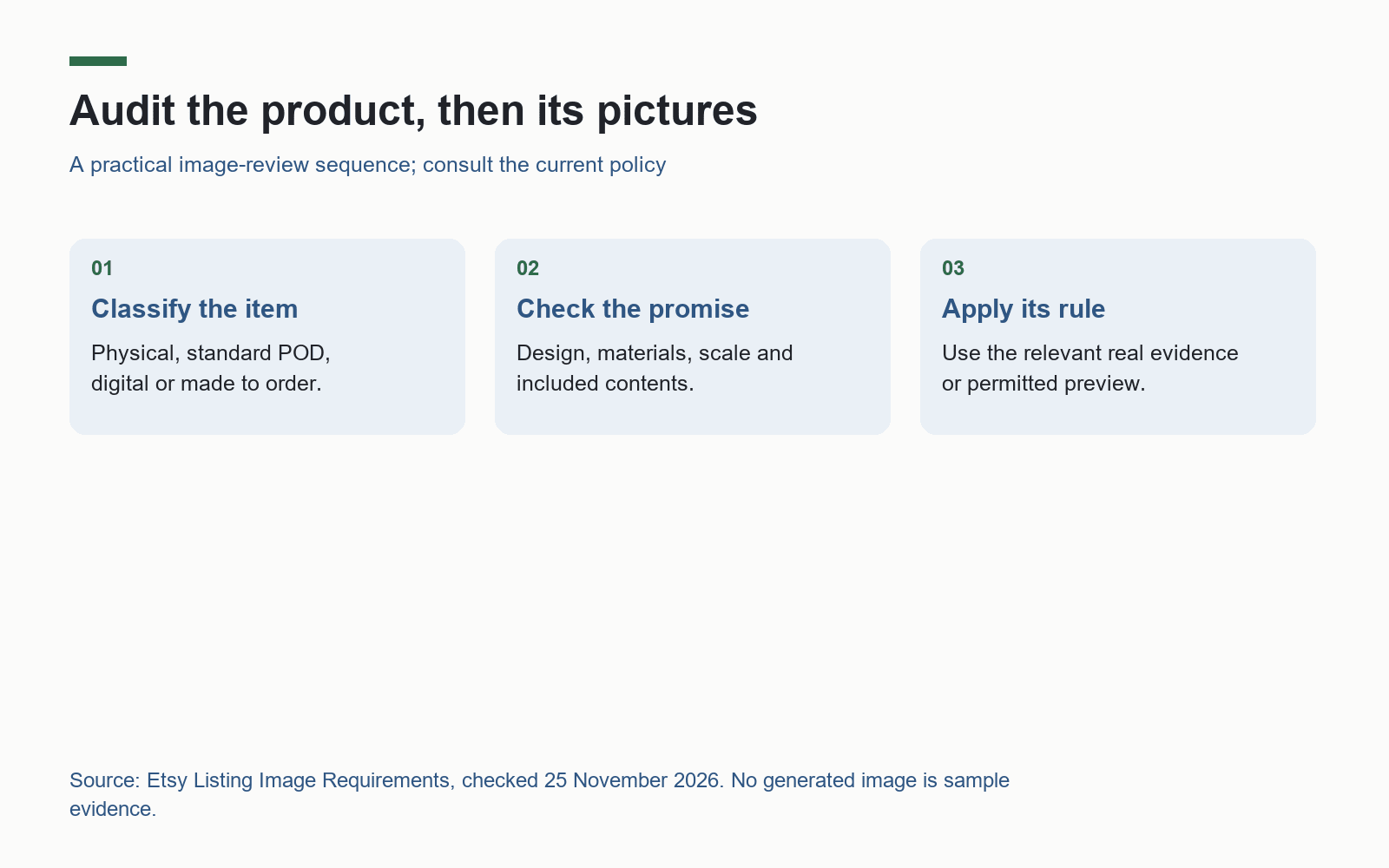
Audit the product category before deciding which image evidence is appropriate. Our practical priority is accuracy first, then the applicable policy requirement.
| Listing | First audit question | Better evidence |
|---|---|---|
| Standard POD base with original artwork | Does the authorised mockup match the selected product? | Supplier specifications and your sample |
| Digital artwork or template | Does the preview show the actual delivered content? | Exported pages or a real file demonstration |
| Custom physical item | Can buyers judge the finished work? | Your own completed-item photographs |
| Functional pattern or instructions | Has the promised result actually been made? | Your tested instructions and result |
Generated editorial photographs in an article are illustrations of an idea. They are not sample-order evidence and should not be repurposed as proof that a particular product exists or has a certain quality.
What to do now
- Group your listings by what is delivered. Separate physical items, standard POD products, downloadable files and made-to-order work.
- Check the most important image promises. Look for misleading materials, impossible print coverage, omitted imperfections and unclear bundle contents.
- Replace weak evidence. Use your own sample photos or the permitted, accurately matched previews for that listing type. Keep the original image files.
- Update the description. Explain dimensions, included files, editable fields and meaningful limitations in plain language.
- Review customer questions. Repeated uncertainty about size or contents is a useful signal that the images need work.
Should you order a sample before expanding a POD range?
Yes: our recommendation is to inspect a sample of the product you intend to sell before expanding its variants. A mockup helps describe an offer; a sample helps you judge the physical result. Record the supplier, product variant and date so the observation stays tied to something specific.
This article explains published marketplace requirements in general terms. For a disputed listing, use Etsy’s current policy and support process rather than treating an editorial checklist as a ruling.
Continue with personalized POD products worth sampling, the design-rights checklist and part two of packaging an original design. The separate Etsy AI terms explainer covers the platform’s content licence.
Sources
- Etsy: Listing Image Requirements, updated November 5, 2026, checked 25 November 2026.
- Etsy: Important updates to AI use, October 22, 2026, checked 25 November 2026.
- Etsy: Working with Production Partners, checked 25 November 2026.
Information only, not financial, tax or legal advice. Fees and prices change, so check the platform before you act. Disclaimer (opens in a new tab)
Was this article helpful?

Comments