




On this page
Shopify AI shopping is expanding, but small sellers should start with accurate product data and reliable fulfilment. Shopify’s October 28, 2026 Fall Edition announcement describes broader access to its catalog, cart and checkout for agents and apps. We checked the release on November 25. New discovery routes are worth evaluating; they are not a forecast of sales for your store.
What happened
Shopify’s Fall Edition developer announcement describes Shop.dev and shop.md, partner checkout capabilities and structured tools for agents on storefronts and checkout. The commercial direction is clear: products can be discovered and purchased through more kinds of shopping experience.
Earlier, Shopify’s March 24 announcement described Agentic Storefronts managed from Shopify Admin. Its October holiday article connects that strategy to seasonal discovery. These are platform announcements, not evidence that a particular small store will attract customers through an AI channel.
Why it matters
A shopping assistant needs to understand what is being sold. Vague titles, conflicting delivery promises and incomplete variant information make an offer difficult to judge, regardless of whether a person or software is reading it.
For a POD seller, product information includes the base item, material, sizing, print method and fulfilment expectations. For a digital product, it includes file formats, software compatibility, licence scope and whether the buyer receives an editable template or a finished export. These details also reduce ordinary customer questions, so improving them has value beyond a new channel.
Our recommendation is to repair the catalog before purchasing an “AI visibility” service. A service should explain the work it performs, the data it changes and how success is measured. Claims about guaranteed placement or effortless revenue are not a useful business case.
What should a Shopify AI shopping checklist contain?
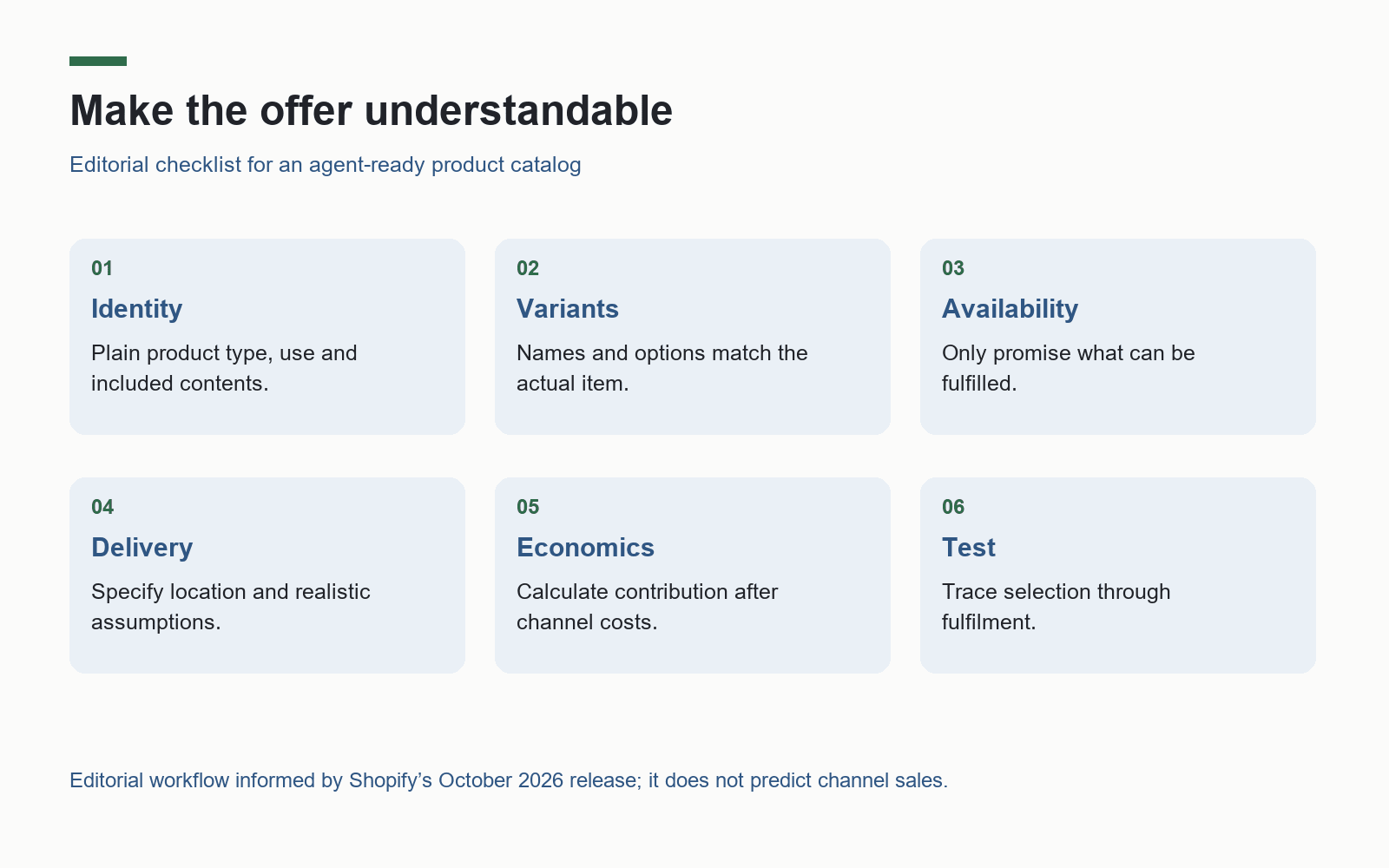
The checklist should make a product easy to identify, compare and fulfil. Use a small collection you understand well before widening the experiment.
| Product information | Useful detail | Acceptance check |
|---|---|---|
| Identity | Plain title and clear product type | A stranger can describe the item |
| Variants | Consistent size, colour and option names | Each option maps to the intended SKU |
| Availability | Correct inventory or fulfilment status | Unavailable options are not promised |
| Delivery | Region and realistic production assumptions | The promise matches the fulfilment route |
| Economics | Current costs and channel deductions | An order leaves an acceptable contribution |
What to do now
- Choose one collection. Prefer products with stable specifications and few unresolved support issues.
- Read each listing as a buyer. Remove contradictory statements and specify what is included. Ask someone unfamiliar with the product to explain it back to you.
- Check the actual channel controls. Use Shopify’s current documentation and the options available to your store. Do not assume an announcement means every feature is enabled for every merchant.
- Trace an order. Check variant selection, checkout, confirmation and fulfilment. Keep tests distinct from genuine customer orders in your analysis.
- Measure retained contribution. Include payment costs, fulfilment, discounts, returns and the time spent fixing mistakes.
Which sellers should experiment first?
Sellers with clear product information, reliable delivery and enough margin to absorb a small experiment are better prepared. If a store already confuses customers or struggles to fulfil orders, fix that before adding discovery channels.
A designer with no established product might benefit more from validating one original design. Someone deciding between files and physical goods should compare digital downloads with POD. Before paying for a storefront, examine the Etsy versus Payhip channel trade-off.
Tip: Write a product information sheet that serves both the listing and your support replies. Clear facts are more durable than trying to guess the wording of the next shopping algorithm.
Sources
- Shopify: Fall 26 Edition for developers, October 28, 2026, checked 25 November 2026.
- Shopify: Agentic commerce momentum, March 24, 2026, checked 25 November 2026.
- Shopify: Holiday agentic commerce, October 6, 2026, checked 25 November 2026.
Information only, not financial, tax or legal advice. Fees and prices change, so check the platform before you act. Disclaimer (opens in a new tab)
Was this article helpful?



Comments