



On this page
Brand deals vs platform ads is a choice between negotiated commercial work and revenue governed by a platform’s earning rules. Checked November 27, 2026, our recommendation for a small specialist creator is to test a tightly scoped brand deal when there is a credible audience fit, while retaining any eligible ad revenue. Avoid treating either route as a guaranteed payment for reach.
How do brand deals vs platform ads compare?
A brand deal pays for what the contract defines; platform ads pay under the applicable program agreement. A sponsor might buy production, distribution, usage rights or a combination. An ad program does not usually buy your services as a commissioned production team.
| Decision factor | Brand deal | Platform ads |
|---|---|---|
| Best fit in this comparison | Specialist creator with a relevant audience and a bounded offer | Eligible creator with repeatable viewing demand |
| What controls the payment? | Signed scope, rights, acceptance and payment terms | Program rules and monetization reporting |
| Extra work | Pitching, negotiation, revisions and invoicing | Program administration and revenue reconciliation |
| Key risk | Unpaid invoices, broad rights and excessive revisions | Variable demand, eligibility and policy changes |
| What reach means | A contract metric only when defined that way | Not every public view creates ad income |
Our pick is specific to a creator who already has useful specialist work. Someone without an audience or a deliverable production skill should build evidence of that value before selling it. This is a decision framework, not a report of our sponsorship results.
When can a small creator be useful to a brand?
A small creator can be useful when the audience’s problem closely matches what the brand sells. A clear demonstration for a narrow professional task may be more relevant than a broad entertainment mention. Relevance is a reason to discuss a partnership, not proof that a brand will buy it.
Prepare a concise portfolio showing the subject, the intended audience and the kind of explanation you can deliver. Use actual reporting with dates where you have it. Do not invent audience demographics, engagement statistics or previous clients.
A brand may instead want content for its own channels. That is a different deliverable from reaching your audience. Separate production services from publishing access so the scope and rights can be priced clearly.
What should a brand-deal quote include?
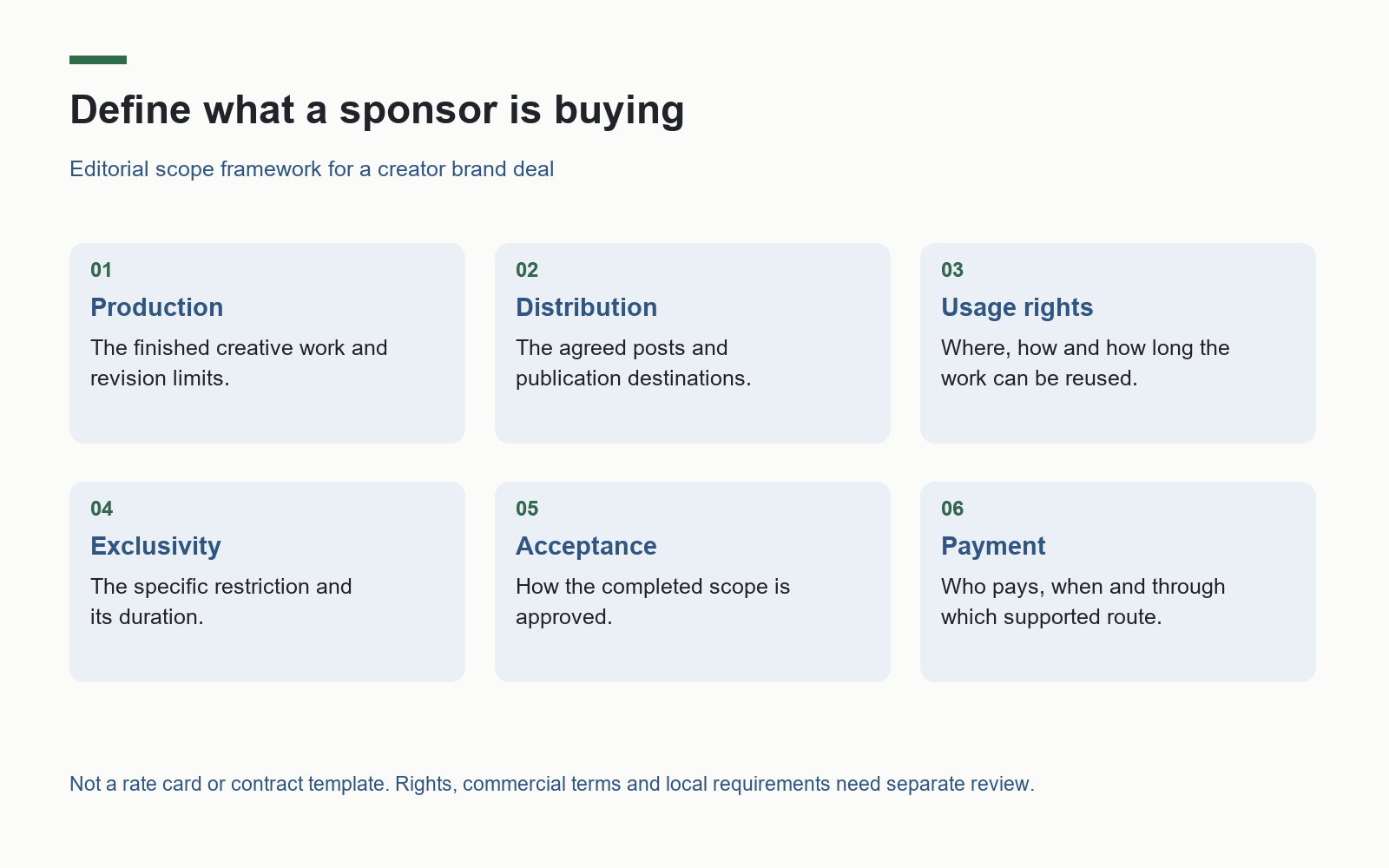
A useful quote defines the finished work and the limits around it. Specify the format, topic, publication destination, draft review, revisions, delivery assumptions and acceptance process. State what the brand must supply and what happens if those inputs arrive late.
Then address rights. Organic reposting, paid advertising, edits, raw footage and use of a creator’s likeness are different permissions. Define the platforms, territory and duration where relevant. Avoid casually granting permanent broad use because the initial content fee looks attractive.
Exclusivity also has a cost: it can prevent other work. Describe the actual category and period rather than agreeing to an undefined restriction on competitors.
For legal or contractual questions, get qualified advice in the relevant jurisdiction. This article is general information, not a contract template or a conclusion that a specific term is enforceable.
How do you calculate a sensible price floor?
Start with all work required, then add cash expenses, the rights being sold and the commercial risk. Do not price from filming time alone. Sales calls, briefing, research, revisions, approval delays and reporting are part of the job.
Hypothetical quote floor: assume eight total hours at an internal target of USD 25 an hour, plus USD 40 cash production costs. That gives USD 240 before additional rights, payment charges, tax and a contingency. It is an invented cost exercise, not a market sponsorship rate or an expected fee.
An audience-based premium may be justified when you have evidence, but a larger audience does not make every campaign suitable. Decline claims you cannot substantiate or a product you cannot recommend honestly.
When are platform ads the simpler choice?
Ads can be administratively simpler once you qualify because you do not negotiate a separate sponsor contract for every eligible upload. You still carry the production risk, and income can vary. YouTube’s earnings documentation explicitly does not guarantee how much a partner will receive.
Use matching views and RPM to estimate the applicable revenue, then subtract costs. Check upcoming YPP changes if a forecast extends into the next rules period.
Do not promise a collaborator that ordinary view counts will cover their invoice unless you can fund the obligation independently. A contracted cost is real even when the ad result disappoints.
What disclosure and payment risks should you manage?
Make the paid relationship clear. The FTC’s influencer guidance explains why a material relationship should be obvious to a US-facing audience. Applicable rules differ elsewhere, and a platform label may not settle every local requirement.
Verify the contracting party and payment route before delivering. Keep an agreed schedule for payment and acceptance, and use legitimate platform or business channels. Avoid sending account passwords or paying an unexplained fee to unlock a supposed sponsorship.
Which one should you choose?
Choose brand deals if you can identify a suitable partner, define a useful deliverable and negotiate clear rights. Begin with work small enough to deliver reliably and a contract you understand.
Choose platform ads if you qualify and your production plan is sustainable without constant client negotiation. Judge the model from actual results rather than a generic CPM claim.
Our default pick: retain eligible ads and test a limited brand offer that fits the audience. Diversify carefully through other creator income methods; adding obligations is useful only when you can fulfil them.
Frequently asked questions
Do I need a large audience to get a brand deal?
A relevant niche audience or useful production skill can start a discussion, but no size guarantees a contract. Show real work and accurate reporting.
Should paid-ad rights be included automatically?
Define them explicitly. Paid use, raw footage, edits and organic reposting can involve different value and risk.
Can I earn ads and sponsorship income from the same work?
Potentially, subject to platform rules, disclosures and the sponsor agreement. Keep the income streams and obligations separate.
How much should a creator charge?
Build a cost floor and price the scope, audience evidence and rights. A single universal fee based on followers would be misleading.
Sources
- earnings documentation, checked November 27, 2026.
- FTC’s influencer guidance, checked November 27, 2026.
Information only, not financial, tax or legal advice. Fees and prices change, so check the platform before you act. Disclaimer (opens in a new tab)
Was this article helpful?


Comments