




On this page
Creator membership pricing should begin with a recurring benefit you can reliably deliver, then the amount left after deductions and work. Checked November 27, 2026, our recommendation is one manageable starting tier with clear limits. More tiers and unlimited personal access create obligations before they create a dependable business.
What do you need before setting a price?
You need a recurring audience problem, a delivery schedule, a supported membership platform and a capacity estimate. Use your existing recording and publishing tools where practical. Budget planning time before launch, plus the actual recurring production and moderation time.
A membership is different from a one-off tip. Members may expect a defined benefit every billing cycle. It is also different from a full course or private consulting arrangement unless those services are explicitly included.
YouTube’s membership-benefit guidance describes recurring perks and how levels can stack. Read the applicable platform’s rules before promising benefits. We are comparing planning choices here, not reviewing a membership we have operated.
How do you build creator membership pricing?
Choose one clear benefit, cost it and test whether a realistic delivery workload fits. Followers are not paying members, so begin with capacity and actual expressions of interest rather than a convenient conversion assumption.
- Define the recurring result. For example, a scheduled group workshop could help members apply the public lessons. Describe the topic boundaries, format and what a member receives even if they cannot attend live.
- Set the service limits. State the frequency, response expectations, recording availability and exclusions. Do not imply unlimited messages, bespoke work or guaranteed personal outcomes.
- Choose a supported platform and allowed tier. Check creator eligibility, available price options and payment terms. A free-form price in your spreadsheet may not be an available platform tier.
- Calculate proceeds after deductions. Use the platform’s actual recognized-revenue rules, applicable tax treatment and payment route. Do not assume the listed customer price reaches you intact.
- Budget fulfilment and moderation. Include preparation, delivery, captions, archive management, replies and failed-payment questions. Reserve time for an ordinary disruption such as illness or equipment trouble.
- Test a bounded offer and review the evidence. Track delivered benefits, member questions, cancellations and retained revenue. Revise the promise before adding tiers or selling greater access.
Tip: Write the cancellation route and the limits of the offer with the same care as the benefits. A member should understand what happens when they stop paying.
Which deductions should your model include?
Use the rules for the payment route that actually applies. For YouTube, its member billing guidance says creators receive 70% of revenue recognized by Google after local sales tax and other applicable fees are deducted. That is not necessarily 70% of every customer’s displayed price.
The same guidance notes that pricing can vary by country and signup platform. This makes a generic global price-to-proceeds calculation unreliable. Use finalized reporting to verify what your actual tier leaves.
For other platforms, check their current fees and tax handling separately. Do not transplant YouTube’s rate into a direct storefront or use a competitor’s headline commission as your total cost.
How do you calculate a membership break-even point?
Divide recurring fixed costs by the contribution from an active paying member, using the same period for both. Contribution means your proceeds after the relevant transaction deductions and variable member costs, before the fixed costs you are trying to cover.
Hypothetical capacity model, not a platform quote: assume recognized revenue of USD 6 per active member per month, an assumed creator share of 70% and USD 0.70 variable member cost. Contribution is USD 3.50. At USD 140 monthly fixed delivery cost, 40 active paying members cover that cost. At 25 members, contribution is USD 87.50 and the shortfall is USD 52.50. This excludes tax, acquisition and any labour not included in the USD 140.
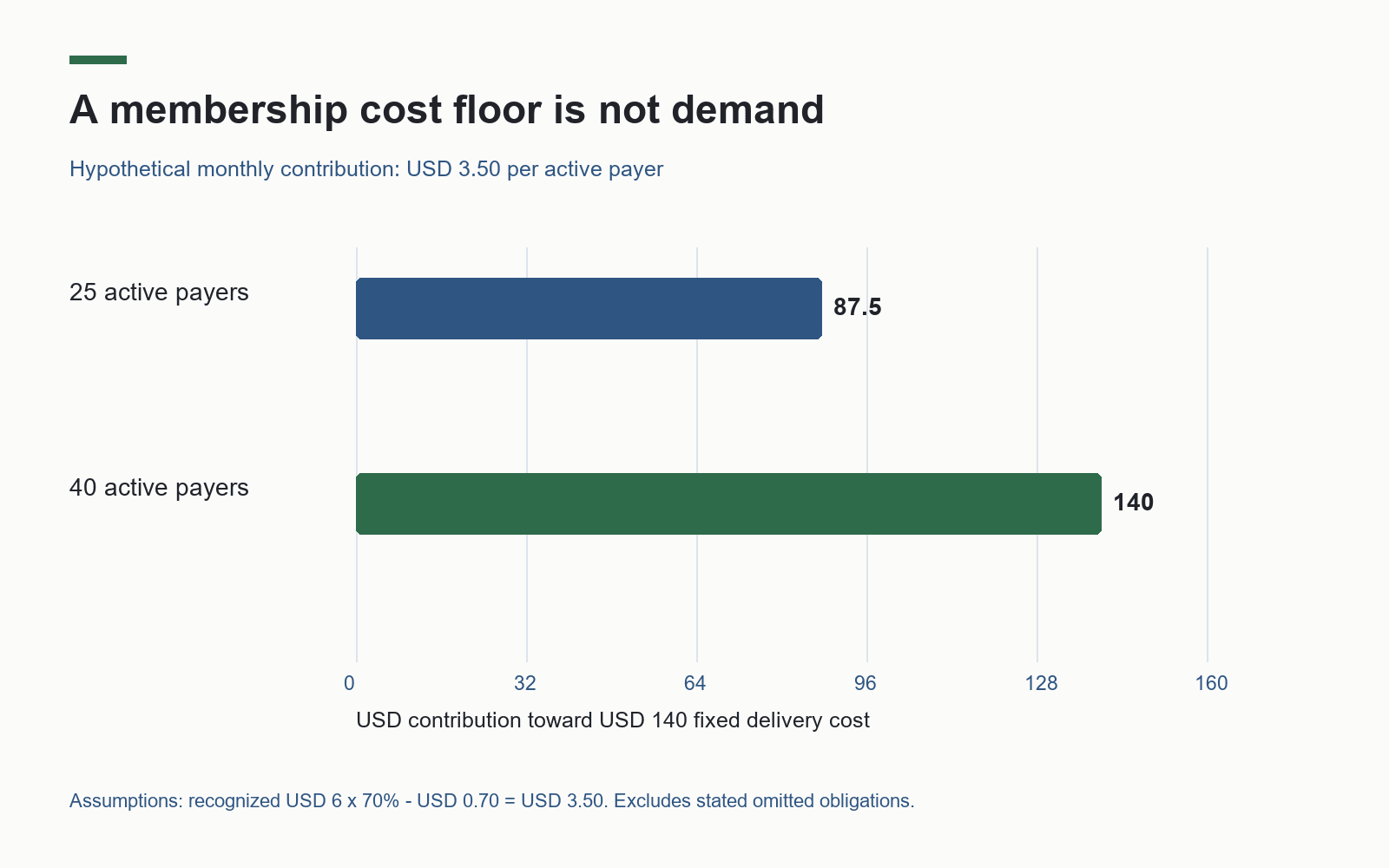
The calculation establishes a required condition, not evidence that enough people will subscribe. If your audience has not expressed interest in the benefit, changing the spreadsheet cannot create demand.
Which benefits are easier to sustain?
Benefits with a clear shared output are often easier to bound than unrestricted personal support. A scheduled group session, an organized resource update or an optional behind-the-scenes explanation can have a visible completion point.
The suitable benefit still depends on the audience. A casual entertainment viewer may want community recognition, while a professional learner may value a well-prepared workshop. Ask about a concrete offer instead of a vague willingness to “support the channel.”
Keep the core promise useful at a small scale. If a benefit only works with a large group, decide how you will serve the early members or delay selling it until the conditions are met.
What should you avoid promising?
Avoid a workload that expands unpredictably with each member. Personal reviews, private calls and unlimited messages require real capacity. If you sell them, define volume, eligibility and scheduling precisely.
Also avoid outcomes outside your control, such as guaranteed audience growth or earnings. Your responsibility is to deliver the stated benefit, not to promise that every member achieves a financial result.
YouTube’s refund guidance distinguishes cancellation from problems with unavailable or defective perks. Read the actual rules before describing a payment as irreversible.
When should you choose another income method?
Choose another method when the audience wants a one-off solution or you cannot sustain recurring delivery. A suitable workshop ticket, bounded service or small merch test may create a clearer obligation.
If viewers mainly want optional encouragement, Hype with Jewels is a different kind of support where available. Compare creator income without ads before committing to a subscription model.
Our recommendation: start with one clearly costed tier, measure delivery and retention, and add complexity only when members demonstrate a need for it.
Frequently asked questions
What is the best creator membership price?
Choose an allowed price that covers a useful, sustainable benefit after the applicable deductions. There is no universal price for every audience.
Should I launch several membership tiers?
One clear tier is our starting recommendation. Add tiers only when their additional benefits and workload are distinct and manageable.
Can I assume followers will become paying members?
No. Use actual interest in a specific offer and then real subscription evidence. A chosen conversion rate is only an assumption.
Are recurring payments passive income?
A defined recurring benefit creates ongoing delivery, support and administration. Include that work when judging the model.
Sources
- membership-benefit guidance, checked November 27, 2026.
- member billing guidance, checked November 27, 2026.
- refund guidance, checked November 27, 2026.
Information only, not financial, tax or legal advice. Fees and prices change, so check the platform before you act. Disclaimer (opens in a new tab)
Was this article helpful?



Comments