




On this page
100,000 YouTube views do not have one reliable cash value. Checked November 27, 2026, the useful estimate uses your channel’s relevant RPM, the same video format and the same reporting period. Our recommendation is to calculate a transparent scenario first, then subtract production costs and compare it with finalized earnings. Public views alone cannot tell you what a creator keeps.
What do you need for a useful estimate?
You need the view count, the video format, the matching revenue metric and a clear cost record. Your own analytics provide better evidence than a claimed average from a creator with a different audience. If you have no monetized history, you can build scenarios, but label the rates as assumptions.
Use a calculator or a simple spreadsheet. Record the currency and whether the metric represents ads alone or a wider mix of platform revenue. Keep sponsorships and merchandise outside an ad-only calculation.
This is a calculation guide based on YouTube’s documentation and explicit examples, not a report of our channel earnings.
How do you calculate what 100,000 YouTube views earn?
Use matching views divided by a thousand, multiplied by the relevant RPM. YouTube’s RPM explanation defines it as creator revenue after YouTube’s share per thousand views; Shorts use engaged views in that metric. CPM measures advertiser spending and is not the same input.
- Choose the format and date range. Separate long-form from Shorts. Do not multiply a Shorts headline count by a long-form rate.
- Choose the revenue you are estimating. If using a broad channel RPM, understand which revenue sources are included. Use an appropriate narrower report when the question is specifically about advertising.
- Match the denominator. Use the views corresponding to that report and format. Do not substitute a public count with a different definition.
- Apply the equation once. A creator-side RPM already reflects the platform share. Deducting that share again understates the result.
- Subtract your own expenses. Count editing, research, assets, travel, software and reasonable equipment allocation. Keep cash costs and the value of your own time visible.
- Reconcile with finalized revenue. Treat an estimate as provisional until the relevant reporting is final and payment conditions are met.
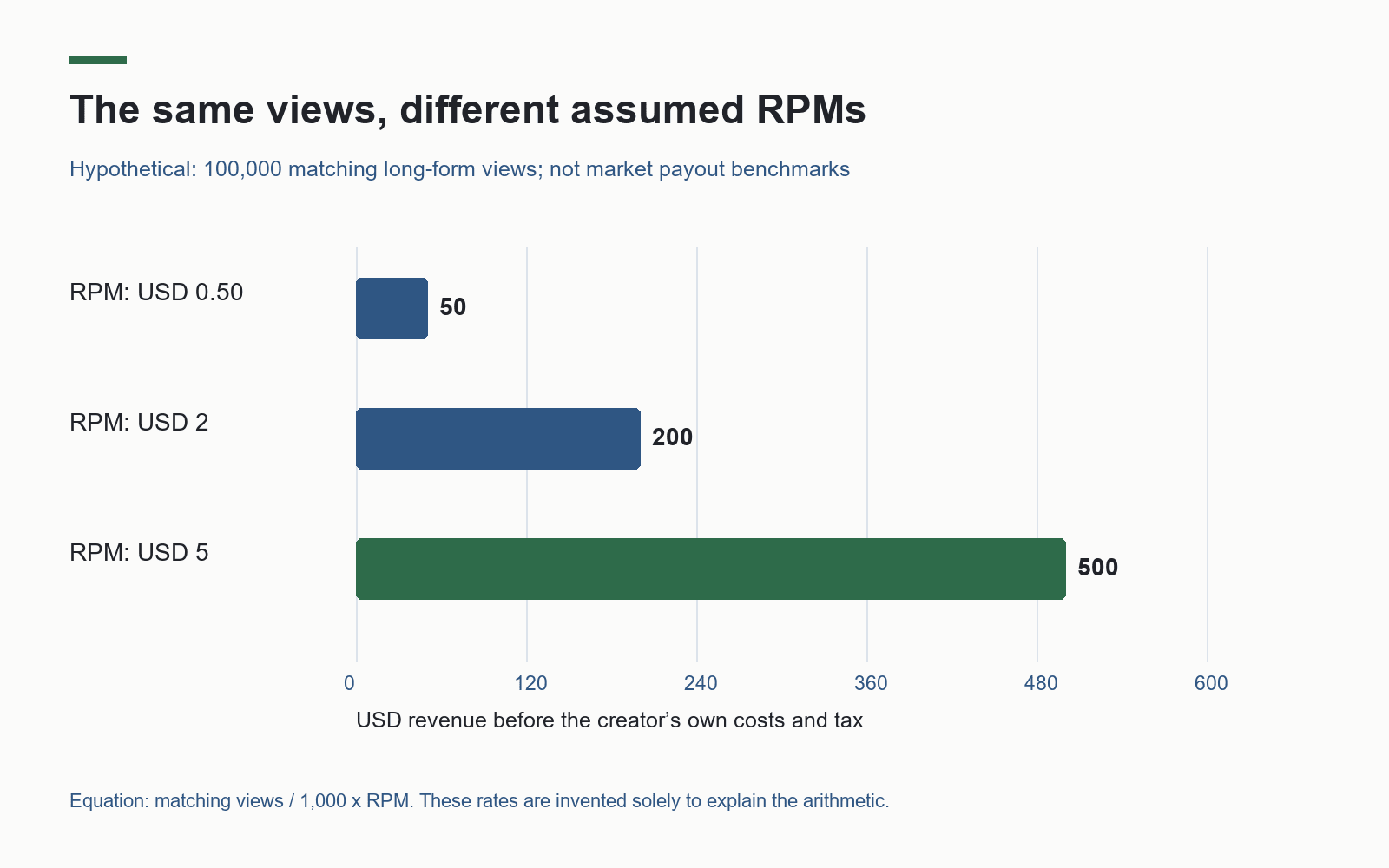
Hypothetical scenarios, not typical payouts: assume 100,000 matching long-form views. At an assumed USD 0.50 RPM, revenue is USD 50. At USD 2 RPM, it is USD 200. At USD 5 RPM, it is USD 500. These rates are chosen solely to explain the formula; they are not market averages, country benchmarks or forecasts.
Why can the same view count produce different revenue?
Not every view produces an ad impression, and the value of available advertising changes. YouTube’s metric documentation describes effects from geography, seasonality and ad formats. Its RPM can also include several platform income sources, while outside sponsorships and most direct merchandise revenue are excluded.
That means two screenshots may answer different questions. One might describe an entire channel, another a single video; one may include fan payments while another shows only ads. Compare dates, formats, currencies and included income before comparing totals.
Our country checklist distinguishes residence-based eligibility from audience-based ad demand. It avoids the misleading idea that your home address sets a universal rate.
How do costs change the result?
Costs determine whether revenue is worth the production effort. A low-budget explanation using equipment you already own can have different economics from a travel documentary, even at the same RPM.
Hypothetical production example: take the USD 200 revenue scenario above. Assume USD 60 editing, USD 15 licensed assets and USD 10 other allocated costs. The remainder is USD 115 before tax and your own labour. If the episode took ten hours of your time, that is USD 11.50 per hour before those remaining obligations. These are invented inputs for arithmetic, not a creator’s results.
Do not describe the remainder as take-home pay without identifying what is still excluded. Revenue after platform share is not automatically profit after all business costs.
Keep a project cost sheet even when the first videos earn nothing. It will show which production choices are expensive and whether your audience values them. A costly animation that viewers skip may deserve a smaller budget than a clear demonstration they finish.
Can you forecast before joining a monetization program?
You can model what would need to be true, but you cannot infer actual payment from an unapproved channel’s views. Passing an entry threshold is not the same as completing approval, accepting the relevant agreement and meeting content conditions.
Use a range of assumptions as a planning exercise, including a no-revenue case. Then ask whether the project remains affordable. Read the announced 2027 YPP changes when planning beyond the current rules.
What should you do with a high-performing video?
Investigate the repeatable audience need before raising spending. Look at why people stayed, which question they asked next and whether the result relied on a temporary event. One unusually successful video is a weak basis for a permanent payroll commitment.
Estimate the next episode from your own comparable reporting, then keep a reserve for weaker outcomes. If the audience asks for a useful paid service or product, compare it in creator income without ads rather than assuming every solution is more advertising.
Tip: Save the date range beside every exported figure. A screenshot without its period, format and included revenue can be impossible to interpret later.
Our recommendation: use RPM as a transparent calculation input, not a promise. Judge a video on its actual retained revenue, useful audience response and total effort.
Frequently asked questions
How much does YouTube pay for 100,000 views?
There is no fixed amount. Use the matching format’s actual RPM and view definition, then account for costs and adjustments.
Should I multiply views by CPM?
No. CPM concerns advertiser spending on ad impressions. It is not the creator’s revenue rate for every public view.
Does RPM already include YouTube’s share?
YouTube defines creator RPM after its revenue share. Do not deduct that share again from an RPM-based result.
Are the example RPMs typical?
No. They are deliberately hypothetical inputs showing the equation. They are not an estimate for your audience, country or topic.
Sources
- RPM explanation, checked November 27, 2026.
Information only, not financial, tax or legal advice. Fees and prices change, so check the platform before you act. Disclaimer (opens in a new tab)
Was this article helpful?



Comments