




On this page
Instagram vs YouTube for long-form video is currently a choice between an emerging distribution experiment and an established creator platform. Checked November 27, 2026, our default recommendation is to keep YouTube as the primary long-form library and test Instagram alongside it if you have access. Choose Instagram as the main relationship channel only when your own audience and actual revenue support that decision.
How does Instagram vs YouTube compare today?
YouTube is the clearer starting point when the goal is to build a repeatable long-form publishing operation. It has documented partner agreements and earnings reporting. Instagram’s longer horizontal format is still a selected-creator test, according to TheWrap’s announcement coverage.
This is a comparison of publishing and business choices, not a first-hand performance test. We have not uploaded matching videos or measured results on either platform.
| Decision | YouTube | |
|---|---|---|
| Main long-form library | Our default for a repeatable series | Additional experiment where access exists |
| Direct video earnings | Documented YPP agreements, subject to approval | No general Features payout assumed here |
| Existing audience | Best when viewers already watch your complete episodes here | Useful when your strongest audience relationship is already here |
| Production cost | Budget the full episode | Budget adaptation, promotion and extra moderation |
| Main risk | Policy changes and uncertain demand | Test access and unsettled long-form economics |
Which platform gives you the clearer earnings model?
YouTube offers the clearer contractual framework for eligible creators. Its partner earnings overview documents the monetization modules; approval and an audience still do not guarantee income.
Instagram can support a creator business through commercial relationships, but an outside sponsor paying for an integration is different from the platform paying for views. A sponsored episode can be valuable without proving that all ordinary uploads earn advertising revenue.
Separate the money in your records: native platform revenue, sponsor invoices, affiliate commissions and direct customer sales. Otherwise you might attribute a successful launch to video views when the real driver was a small group of loyal buyers.
The distinction also helps when comparing a screenshot from another creator. A headline revenue total may include several products or payment types. Ask which dates, formats, costs and income sources are included before treating it as a benchmark.
Where does the audience relationship fit?
Your existing audience can outweigh a platform’s general strengths. If people already ask detailed questions in Instagram comments and return for your Stories, a full episode could serve those viewers well. If viewers find your videos through persistent tutorial searches, preserving a useful YouTube library may be more valuable.
Meta’s Instagram for TV roadmap points toward longer stories and shared viewing. That suggests a possible additional use case. It does not demonstrate that your followers want to watch your entire lesson on a television.
Ask a concrete question before publishing: what does the complete video help the viewer do? A short clip can introduce the problem; the long video must resolve it. Sending people from one incomplete teaser to another makes the whole experience weaker.
How can you run a fair comparison?
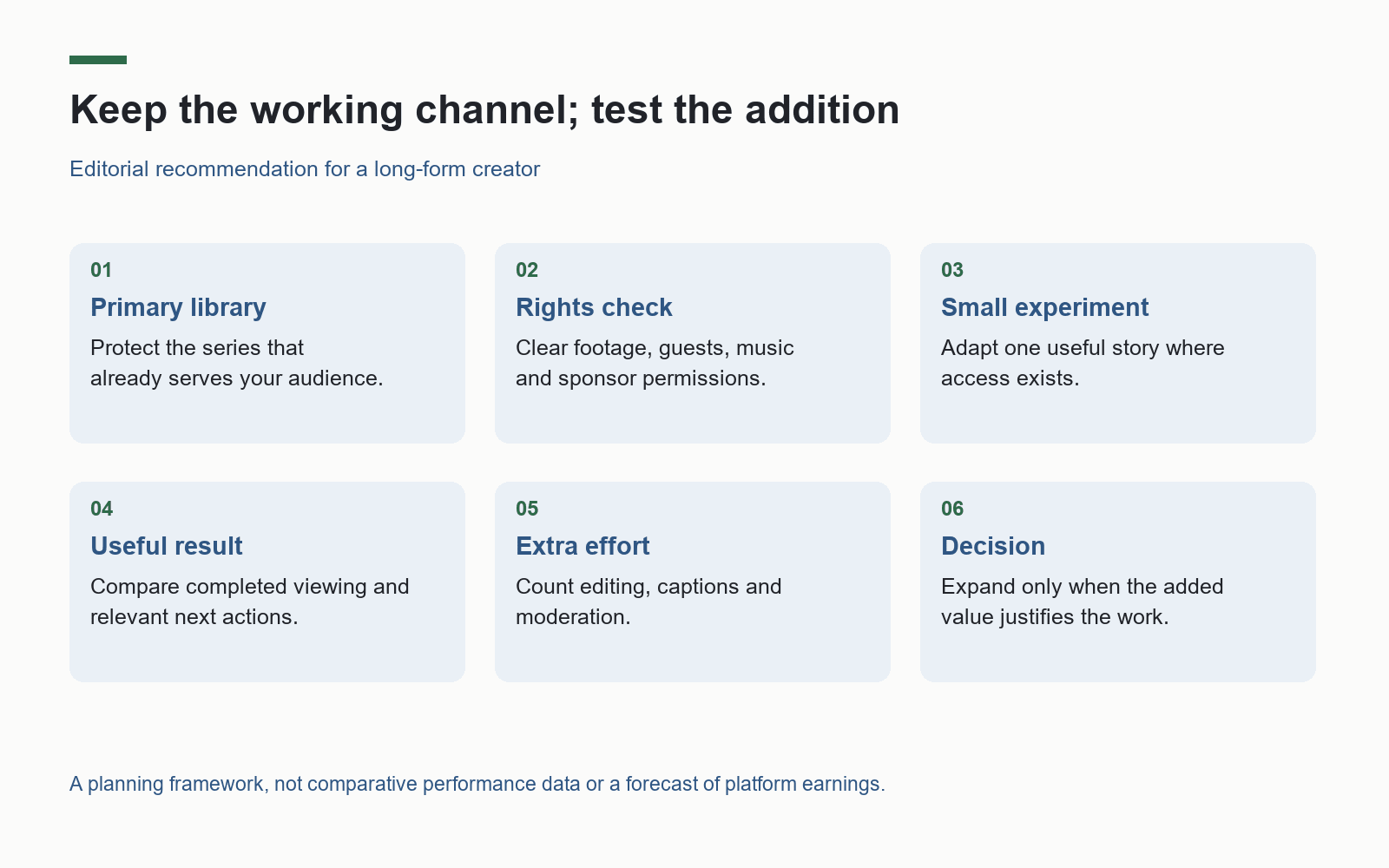
Compare the same underlying audience problem and a similar publication window, while allowing each introduction to fit its platform. Use your own original footage and verify licences for music, guests, graphics and paid integrations before distributing it again.
Keep the first experiment small enough to learn from. Record the master edit time once, then the additional time spent on each version. Count captions, thumbnails, comment replies and export problems. Shared production cost is real, but it should not be charged twice when judging the incremental experiment.
Define a useful outcome beyond reach. For an educational channel, it could be completed lessons and returning viewers. For a product creator, it could be qualified product-page visits and orders that remain profitable after returns. For a sponsor, it should match the objective agreed in the contract.
Use consistent definitions where possible and document where platform metrics differ. Avoid declaring a winner because one interface shows a larger headline number. Read what YouTube views can earn before converting attention into a revenue forecast.
Which costs can make cross-posting unattractive?
Adaptation can become expensive when the content relies on platform-specific features or promises. A sponsor may have bought exclusivity, a music licence may cover only one destination, or a call to action may send viewers into a checkout that they cannot use.
There is also a capacity cost. Extra uploads create more comments and more opportunities for missed customer questions. A second channel that weakens the main series may be a poor trade even when its direct upload costs look low.
Keep a clean production master and a simple rights log. Set an effort limit before experimenting. If the extra channel requires a different production strategy, evaluate it as a new project rather than describing it as effortless reuse.
Which one should you choose?
Choose YouTube if you want a primary long-form catalog, documented monetization routes and a repeatable publishing plan. Read the announced YPP changes for 2027 before relying on today’s entry rules indefinitely.
Choose Instagram if your account has the relevant access, your strongest audience is there and you have a specific reason for a complete episode. A viable sponsor or customer offer can justify a test without an assumed per-view payout.
Our default pick: maintain YouTube as the long-form base, use Instagram as a measured addition, and expand only when the results justify the extra work. Compare brand deals and platform ads when deciding what the attention should support.
Frequently asked questions
Should I leave YouTube for Instagram long videos?
Keep the established channel while you test. A new format alone does not demonstrate a more reliable audience or business model.
Can I upload the same original video to both?
Check every licence, guest permission and sponsor agreement first. Owning the footage does not necessarily clear all included material for another platform.
Which platform pays more for long videos?
There is no sound universal comparison for this test. Compare your actual eligible revenue and total costs, without assigning an invented Instagram rate.
Do I need different videos for each platform?
You can retain the core story while adapting the opening and call to action. Compare the extra effort with the useful audience response.
Sources
- TheWrap’s announcement coverage, checked November 27, 2026.
- partner earnings overview, checked November 27, 2026.
- Instagram for TV roadmap, checked November 27, 2026.
Information only, not financial, tax or legal advice. Fees and prices change, so check the platform before you act. Disclaimer (opens in a new tab)
Was this article helpful?



Comments