




On this page
YouTube Shorts vs long-form revenue is best compared through retained earnings and total production time, not equal public view counts. Checked November 27, 2026, our default for a detailed educational business is a useful long-form series, with Shorts supporting discovery when they serve a clear purpose. A creator whose own results favour short work can reasonably choose a different production mix.
How does YouTube Shorts vs long-form revenue differ?
The formats use different revenue mechanisms and reporting definitions. YouTube’s partner earnings overview lists a 55% share of net watch-page ad revenue under the relevant module and 45% of a creator’s allocated Shorts Creator Pool revenue under the Shorts module. Those percentages apply to different bases and do not establish a per-view earnings ratio.
Do not conclude that a small difference between the headline percentages means the formats pay almost the same. The amount allocated, the eligible views and the production costs all matter.
| Question | Long-form | Shorts |
|---|---|---|
| Best editorial use | Complete explanations, interviews and demonstrations | One focused idea or a useful introduction |
| Revenue comparison | Use matching watch-page reporting | Use the appropriate Shorts reporting |
| Main effort to count | Research, structure, recording and full edit | Idea selection, concise edit and repeated publishing |
| Common measurement error | Using channel-wide revenue for one video | Using a headline public count as a matching earnings denominator |
| Our default role | Primary library for a detailed educational offer | Additional discovery where the effort earns its keep |
This is a framework based on official rules and editorial judgment. We have not run a controlled upload experiment, and the recommendation is not a prediction that every long video earns more.
Which one offers more value to your viewer?
Long-form fits a question that needs context, a sequence or evidence. A repair demonstration may need diagnosis, the actual procedure and a check of the result. Cutting away the essential explanation to fit a short format can leave the viewer unable to act.
Shorts fit a complete compact answer, a striking observation or a useful entry into a larger subject. The strongest short version can stand on its own while making the full lesson worth watching. A teaser that withholds every useful detail gives viewers little reason to trust the next link.
Choose the format after identifying the job. If a question can be answered clearly and fully in a short video, adding length merely to seek more revenue can make the work worse.
How should you compare the business results?
Compare completed production cycles, including the time needed to generate ideas and handle audience response. Publishing many short videos is not automatically cheaper than making a carefully planned long episode.
Use the same comparison period and keep shared work visible. A long episode may supply footage for shorter explanations, but choosing and editing those clips takes additional effort. Avoid counting the master production cost twice or treating the clip work as free.
Measure each format against its intended role. A discovery clip may be valuable when it brings the right people to a complete lesson. A full lesson may be valuable when people return, learn and trust the next recommendation. Those outcomes need evidence from your own reporting.
What does a fair cost example look like?
It includes the whole workload and labels every assumed figure. Use this example as a worksheet structure, not as a benchmark for either format.
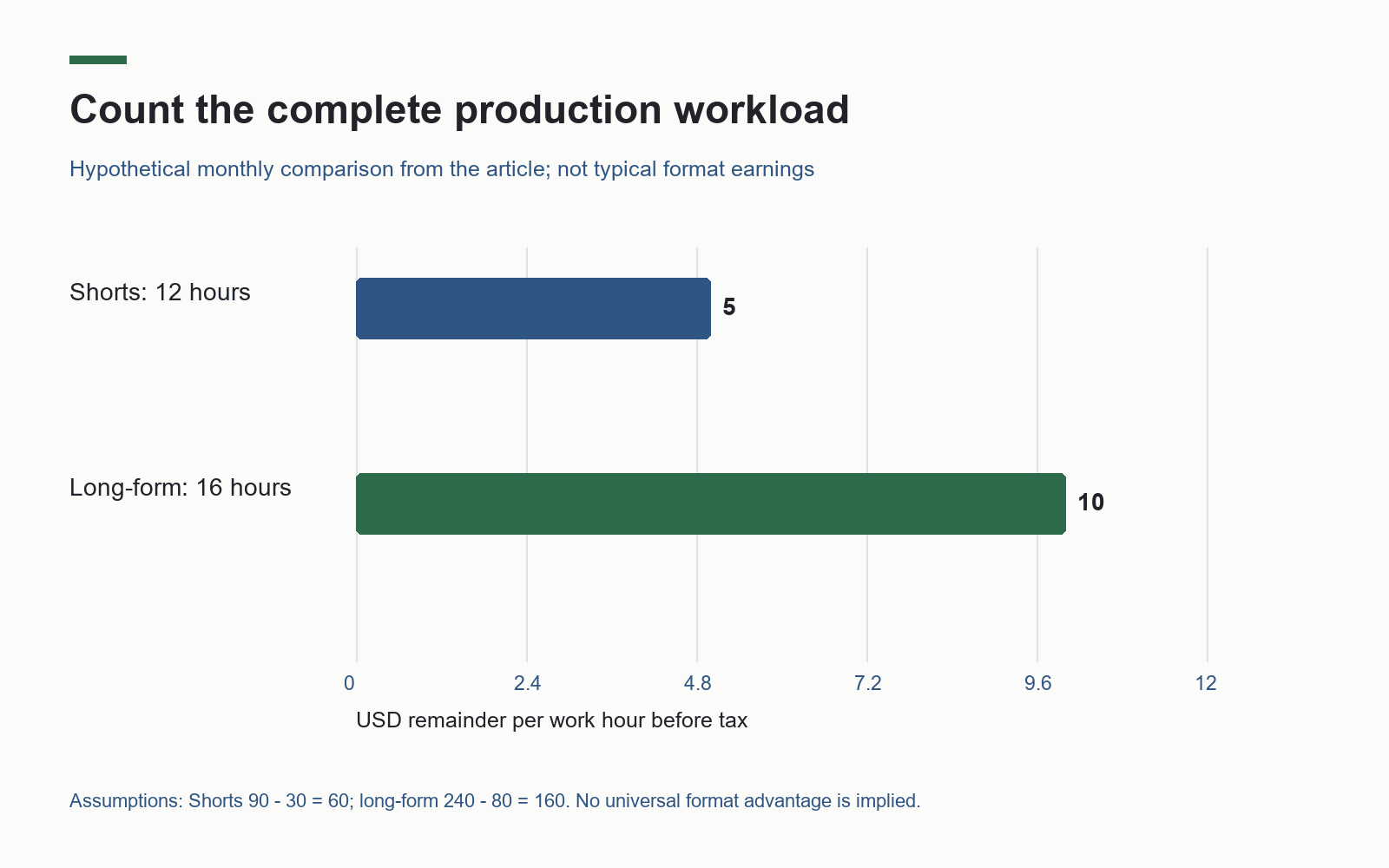
Hypothetical monthly comparison: assume long-form earns USD 240 and costs USD 80 in cash expenses across 16 hours of work. Its USD 160 remainder is USD 10 per hour before tax. Assume a Shorts workflow earns USD 90 and costs USD 30 across 12 hours: USD 60 remains, or USD 5 per hour. These invented values demonstrate the calculation only. Reverse the inputs and the preferred format could change.
The example also excludes future effects such as a returning audience or product purchases. Record those separately when you can attribute them credibly. Do not assign a convenient sales value to every follower just to make a weak format look profitable.
Use our views and earnings guide when choosing the inputs. Sponsorships belong in their own line because they do not operate like an ad RPM.
What changes in February 2027?
YouTube has announced an ongoing Shorts performance requirement for Creator Pool earnings beginning February 1, 2027. Falling below it does not itself remove YPP membership or stop long-form revenue, according to its official changes page. Read the full change explainer for the threshold and terms deadline.
Keep this distinction in a forecast: a channel can remain a partner while a particular earning route is unavailable. Treat future incentives as additional opportunities after invitation and confirmation, rather than guaranteed replacement income.
Which one should you choose?
Choose long-form if your subject needs a complete explanation and you can sustain the production standard. Our default for an educational creator is to make that useful library first, then repurpose suitable ideas thoughtfully.
Choose Shorts if you have a clear short-form concept and your actual results justify the workflow. Measure qualified outcomes and costs, not just the excitement of a large public view count.
Choose a mixed approach if short explanations reach suitable viewers without draining the resources needed for the main series. Review the mix after comparable production cycles and stop the work that does not contribute.
If revenue is the priority, consider brand deals versus platform ads as a separate decision. The most suitable business model may depend more on audience trust and a deliverable offer than on the length of the upload.
Frequently asked questions
Do long videos always earn more than Shorts?
No. Compare your own matching revenue reports, production costs and audience outcomes. A universal earnings ratio is not supported here.
Can I compare equal public view counts?
Public counts may use different definitions and do not reveal the eligible revenue base. Match the format and metric before calculating.
Are clips from my long videos free to produce?
No. Selecting, editing, captioning and publishing clips requires additional work, even when the underlying footage already exists.
Should a new channel publish both formats?
Start with the format that answers the audience’s question well. Add the other only when you can state its purpose and measure its extra effort.
Sources
- partner earnings overview, checked November 27, 2026.
- official changes page, checked November 27, 2026.
Information only, not financial, tax or legal advice. Fees and prices change, so check the platform before you act. Disclaimer (opens in a new tab)
Was this article helpful?



Comments